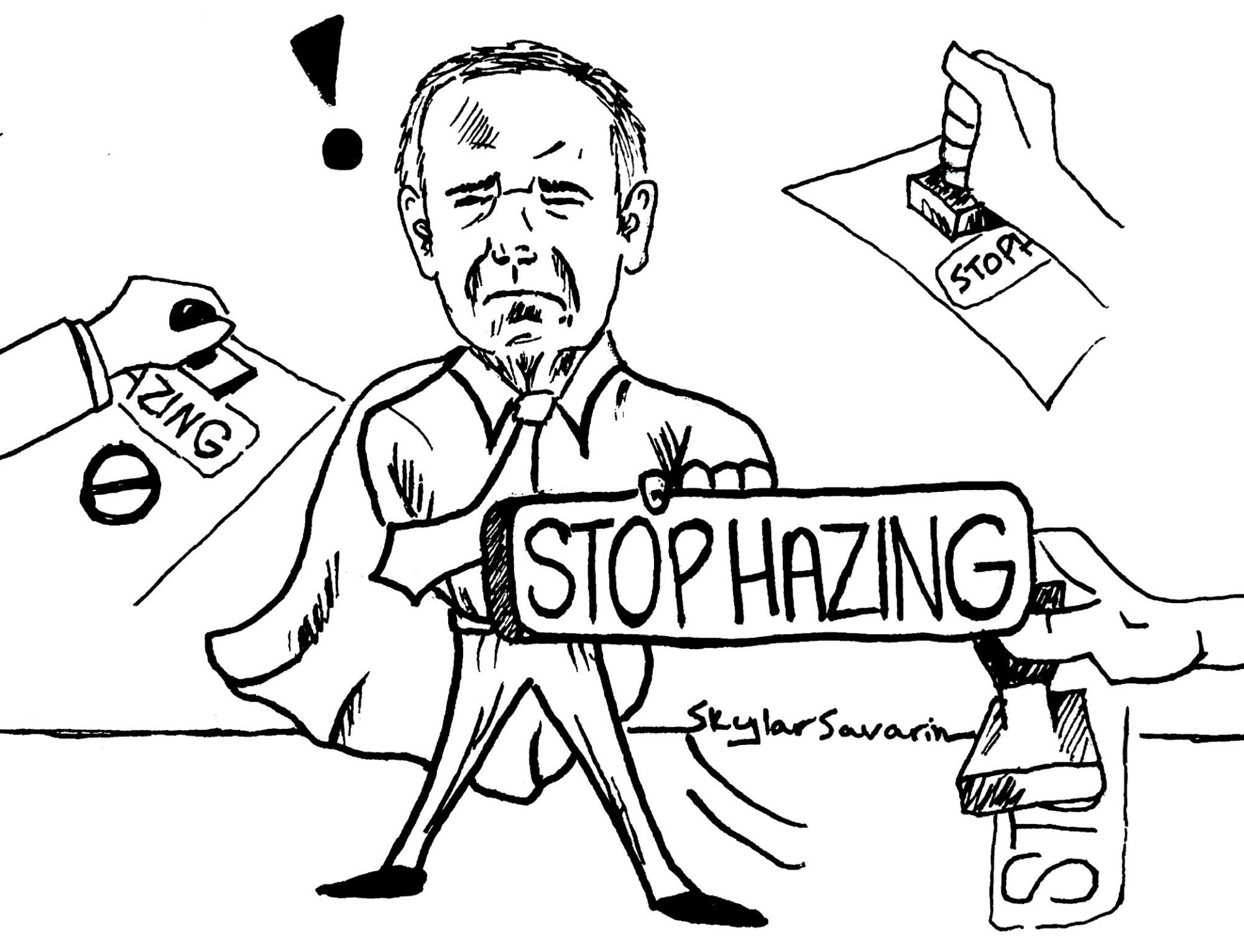
Trinity established a new hazing policy that went into effect at the beginning of this semester. The Dean of Students’ Office spearheaded the change, working in tandem with the Department of Student Engagement and Development, Wellness Services and Athletics to create a new policy explicitly outlining how hazing is prohibited on state, federal and university levels. Biden’s law from last year prompted the change, according to the Vice President of Student Affairs Andrew Wells.
In December 2024, former President Joe Biden signed the Stop Campus Hazing Act into law, requiring all universities receiving government funding to establish hazing prevention policies and procedures. The act also mandated each university to publicly report its hazing incidents. Following this mandate, all hazing incidents at Trinity reported to TUPD or local law enforcement will be available on the TUPD website beginning in January 2026.
Federal and state statutes have existed since the 1990s and define hazing as a criminal offense, and Andrew Wells said that Trinity already held a no-tolerance policy around hazing.
Up until this summer, Trinity has not had a policy dedicated solely to hazing; instead it has had multiple “value-based” policies. Wells shared that this new policy is a catch-all of these past initiatives, combined with federal and state statutes.
Wells said that we should expect to see more workshops, training and discussions, but that overall, the expectations for FSL have not changed. However, hazing incidents have occurred outside of Greek life. Wells said that this new policy applies to every organization on campus.
“Sterotypically, people make the assumption that hazing is a fraternity and sorority concern, but it’s not. It’s much broader than that,” Wells said. “So that office obviously has a lot of engagement in prevention work and training work, but they’re not the only group. Hazing can happen in other settings as well.”
Since Trinity already had guidelines in place to ensure that hazing was barred from campus, Omega Phi member Robin Gemanaru, senior biochemistry and molecular biology major, said that he doesn’t think this new policy will come with any significant changes.
“It will definitely change the way orientation is conducted, because now people will be way more careful about it,” Gemanaru said. “However, in recent years, it’s been shown that when these organizations do haze, and they get found out, bad stuff happens to them. They get either put on social probation, or they get removed from campus and they’re just in big trouble.”
Trinity’s commitment to publishing hazing incidents could be helpful for students, according to Gemanaru.
“We don’t know what happens in other organizations, so it’s really hard to determine whether this is a real problem or not. So by releasing quantifiable figures, students can really understand how frequent, how prevalent, this issue really is,” Gemanaru said.
Alpha Kappa Psi member Sasha Leon, junior sociology major, said there is a fine line between hazing and rituals. She said that as long as someone has the ability to say no to something and no boundaries are crossed, some practices should be okay. Leon recounted a story about her mother, Jennifer Hance ‘93, experiencing hazing at Trinity.
“Something they had to do was strip down to their underwear and bras and be sprayed with hoses while blindfolded,” Leon said. “That’s a story I’ve heard her tell fondly.”
But as of 2025, Leon said that it won’t make much of a difference compared to recent standards. However, she said that things will be stricter for the incoming new active classes.
Categories:
New hazing policy introduced at Trinity
Stop Campus Hazing Act prompts Trinity’s new hazing policy

September 7, 2025
Donate to Trinitonian
$890
$1500
Contributed
Our Goal
We would greatly appreciate any amount you can offer to support student journalists at Trinity University! As one of few remaining weekly print student newspapers, we rely on the generosity of our audience to continue serving the community. Your contribution will enable us to continue delivering informative news to the student body and uphold our commitment to quality community journalism.
More to Discover