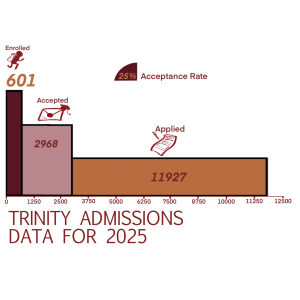
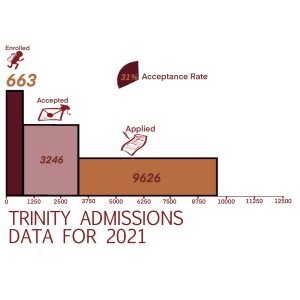
Trinity University’s class of 2029 saw the lowest acceptance rate in university history, dropping to just 25%. The first-year class is composed of only 601 students, a steep decrease from the previous four years’ average of 657. The steadily shrinking acceptance rate amplified the university’s reputation in the eyes of both potential applicants and employers of Trinity graduates, according to the Admissions Department and Center for Experiential Learning and Career Success (CELCS), and freed up space for Residential Life. Sophomores, juniors and seniors now occupy C.W. Miller Hall, which is historically a first-year dorm.
According to Residential Life’s Assistant Director for Housing Operations Stephanie Keith, the decision to turn Miller Hall from first-year housing to upper-division housing was inextricably linked to the smaller-than-usual size of the first-year class.“This year was a big example of a first-year class that was much smaller than we were used to, and so with that class number being lower, we had an opportunity to leverage that resource to serve another part of our student population,” Keith said.
The resource in question was Miller Hall, which houses 60 residents. Because they had 601 students to fit in five buildings that can house 764 residents in total, Residential Life had the opportunity to house seniors who may not have been able to live on campus this year, as well as juniors and sophomores. Whether or not Miller will continue to be upperclassmen housing or will revert back to first-year housing is unknown to Residential Life, according to Keith.
Dean of Admissions Justin Doty said that the original goal for the class of 2029 was around 635–640 students. While this initial goal was still smaller than previous class sizes, the actual size of 601 is lower than this first projection. Doty said this may be partly due to recent economic uncertainty and backlogs with international student visas. According to Doty, 622 students had submitted a deposit by May 2 of this year, meaning 21 did not end up coming to campus on move-in day, possibly for those reasons.
Due to these factors, Doty said it’s difficult to predict the size of next year’s class, and therefore also difficult to predict the future of Miller Hall.“There [were] a lot of outside forces, some headwinds that we were facing,” Doty said.
On top of causing ripple effects in Trinity’s present, such as the usage of Miller for upperclassmen, these smaller numbers could also have implications for our future, such as more name recognition and prestige due to selectivity.
“There are a lot of families that are paying attention to [the acceptance rate] as part of their college search and college criteria. It may not be a driving factor, but in my mind, I’d rather Trinity be in that conversation,” Doty said.
The 25% acceptance rate of the class of 2029 is not a noticeable departure from the class of 2028’s 26%, but it does demonstrate a larger decline over the past few years. Doty said the class of 2025, only five years ago, had an acceptance rate of 34%. He said this downward trend is due in part to the rise in overall applicants, especially those who apply early decision. A record 32% of the class of 2029 applied via early decision, beating last year’s 25%.
“We’re already filling a third of our class through ED, so we can be a little more judicious on early action and regular,” Doty said.
Trinity’s acceptance rate decreasing may also help in the employment arena for Trinity gra
duates, according to Katie Ramirez, director of CELCS. Ramirez said employers previously unfamiliar with Trinity may be impressed with the university’s selectivity, distinguishing Trinity students from the get-go.
“Combined with our national rankings and positive outcomes rate, this reinforces Trinity’s reputation as a destination of choice and strengthens the long-term value of a Trinity degree,” Ramirez wrote in an email. It’s impossible to predict the future of admissions. But, Trinity’s current increase in selectivity and decrease in student population foreshadow multiple positive outcomes, such as more housing for upperclassmen, extra weight to Trinity graduates’ resumes and a boost in the university’s reputation, according to Trinity officials.