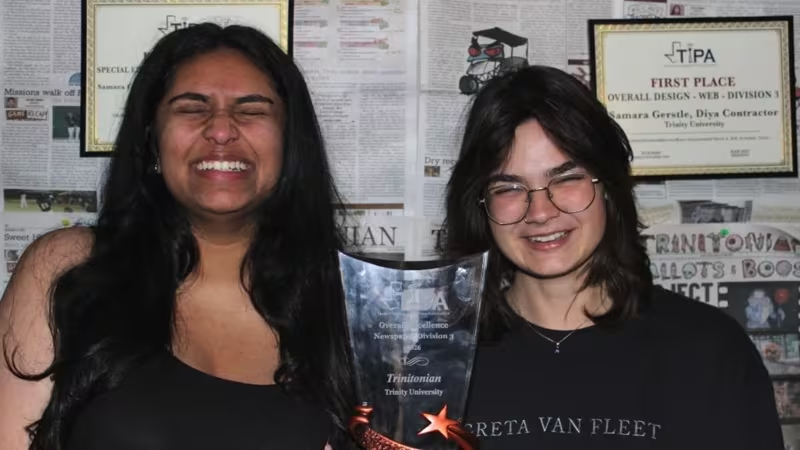
I like to think that the Trinitonian has garnered a good reputation for itself. We won best small all-around newspaper in Texas and Oklahoma in 2024, so this isn’t solely my vanity.
However, this conviction falters every time a source denies a reporter an interview for a grudge that predates both my time on the Trinitonian’s editorial team and my time at Trinity.
I know there are several reasons why people might deny an interview with a reporter, and only a fraction of those concern the Trinitonian’s past or current behavior. But that fraction is significant, and it’s why I’m writing this editorial: Let’s call a truce.
Samara Gerstle, Trinitonian editor-in-chief, and I spent our summers working to hire and train a staff of around 50. Each writer has spent more than eight hours in training sessions learning the ins and outs of journalistic integrity, interview etiquette and reporting. They know how to do research on their subjects in advance, and they know how to be journalists.
But our readers and interviewees aren’t journalists. They aren’t privy to the shorthand, procedures and jargon that journalists rely on. This gap worries me, because as an interviewee, you may be operating with only a surface-level understanding of journalistic principles — leaving you at a disadvantage in your conversations.
To rectify this, I’ve compiled a list of the lingo that we use here at the Trinitonian. My hope is that, whether you’re a reader, an interviewee or simply a member of the Trinity community, you’ll always feel on equal footing with the reporter asking you questions.
The Trinitonian and its staff
Trinitonian: The Trinitonian is an independent, student-led publication. Our work is free of administrative interference and is decided solely by us, the students.
Executive Editorial Board: That’s a mouthful, don’t you think? The executive editorial board consists of the editor-in-chief (Sam) and the managing editor (Diya). We do a whole bunch of things — like running the Trinitonian — but ultimately, nothing gets published unless we see and approve it first.
Editorial Board: This consists of our section editors and copy editors. Our section editors manage their individual columnists and reporters, edit their pieces and ensure their section meets the highest standards every week. Our team of four copy editors look at every single article multiple times, fact-checking and implementing Associated Press (AP) and our in-house Trinitonian styles.
Reporters: Report on content that is important and relevant to the Trinity community. When a reporter interviews you, they will introduce themselves as a reporter and ask you objective questions intended to elicit passionate and informative responses.
Columnists: Write columns from their personal viewpoints backed up with facts and research. When a columnist interviews you, they will introduce themselves as a columnist and ask opinionated questions.
Important facts for readers
Articles: Articles are typically written by reporters, who seek out the truth to provide factual, unbiased coverage of events, issues and other happenings at Trinity.
Columns: Columnists write columns to share their thoughts and opinions on an issue. Columns intentionally represent the views of that individual alone, and not the entire paper.
Editorials: Editorials are written primarily by Sam and I, but sporadically by members of the Editorial Board. The intent behind an editorial is to represent the stance of the Trinitonian.
On the record: Questions and answers given on the record are at liberty to be published. Your interviewer must ask if you are OK with an interview being on the record.
Off the record: Questions and answers shared off the record are considered unofficial and can’t be published. To make this clear, you have to state “off the record” before you share the information — adding it afterwards doesn’t count. There are rare exceptions, usually when highly sensitive details are involved, but as a rule, if you don’t say it up front, it’s fair game.
On Background: On background means the information can be used in reporting, but without naming you directly. Instead, reporters will describe you in a more general way — like “a university official” or “someone close to the campaign.” It gives context while protecting your identity.
My goal in creating this list is to bridge the gap between the Trinitonian and the Trinity community. Faculty, staff and students’ trust is essential to the Trinitonian’s function; we don’t exist without it. We need the support of the Trinity community to ensure that we’re not a tabloid. On behalf of the Trinitonian staff, if there’s anything that we can do to improve our publication, please let us know using the QR code to the right.