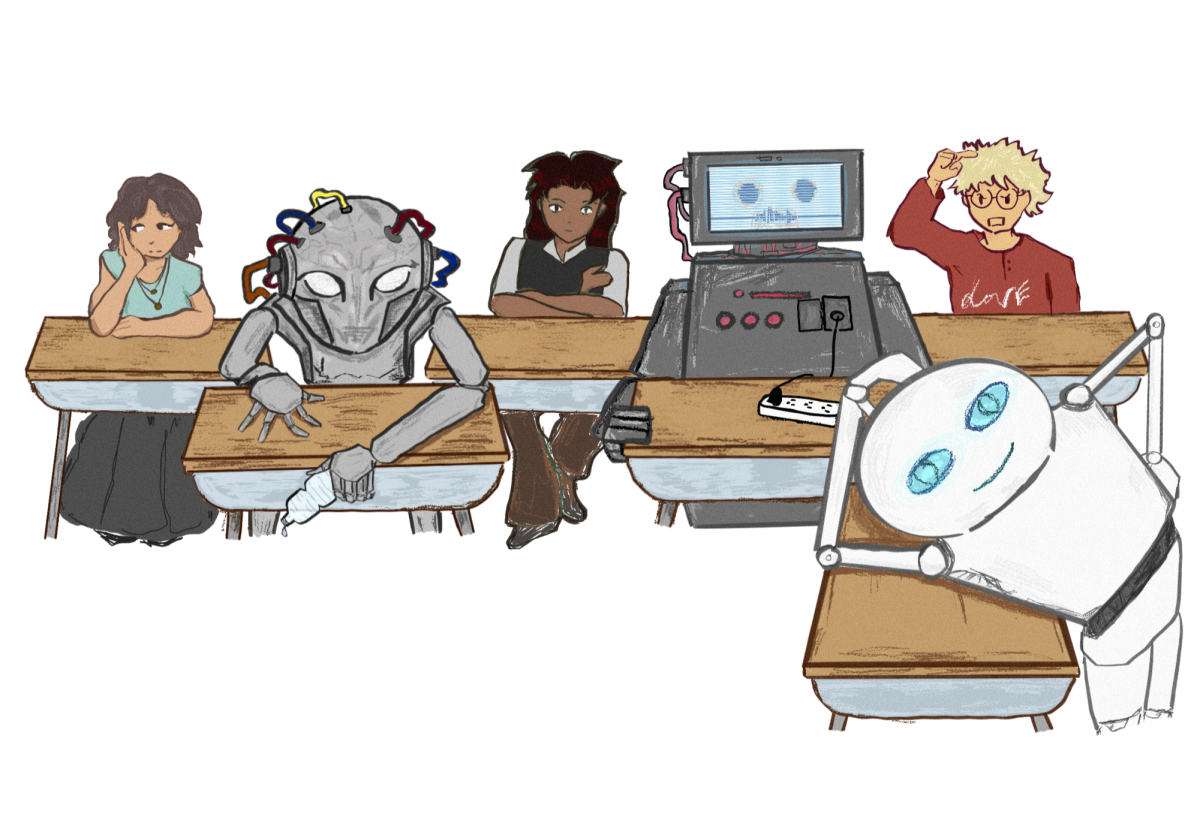
Trinity is considering AI services for student and faculty use in classrooms, according to Information Technology Services (ITS) officials and emails to faculty. Since last semester, the university has been researching and piloting AI services that would provide premium AI programs and other tools to students and faculty to help build AI literacy and keep up with current trends in higher education.
One service Trinity is considering, BoodleBox, consolidates access to many AI bots like ChatGPT or Gemini into one website with increased data security measures, according to Academic Technology Manager Kevin Hearn. Among other tools, the program also provides users with their own trainable bots. BoodleBox allows students to use different AIs for the different tasks they’re specialized for, such as using Claude for coding or Gemini for large information processing. Trinity piloted the website last semester, but has not committed to a larger, paid pilot at the time of writing.
BoodleBox is also relatively cheap, according to Hearn, costing $150,000 to $200,000 per year for “unlimited” university-wide usage. This is compared to other, more expensive contracts, such as University of Southern California’s $3.1 million deal with OpenAI. Hearn expressed doubts about BoodleBox’s claim of “unlimited” usage due to the expensive nature of AI, but he said he was not throttled while piloting the website.
Trinity has not committed to BoodleBox or any other service yet, according to Hearn. He stated that he and ITS will thoroughly vet the platform’s data protection security and how well it fulfills Trinity’s goals of AI literacy before entering a contract with BoodleBox or any other company that offers similar services, such as NebulaONE or Amplify AI. Hearn also said that this will likely be a slow process, happening over the next few years.
“I really hope that Trinity slowly, methodically, purposefully rolls this out in a way that lets our students have an advantage and use it in the future,” Hearn said. “Because, again, we should not buy the shiny thing because it’s shiny, but I like that we could make it available someday.”
ITS is focusing on academic privacy, Hearn said, since any platform Trinity decides to purchase would have access to student academic documents and possibly sensitive information, like grades. BoodleBox states on their website that they anonymize and encrypt all data sent to third parties, which Hearn said ITS is prepared to “aggressively enforce.”
Hearn also said he is aware of faculty concerns about allowing students easy, university-sponsored access to powerful AI bots. BoodleBox allows the university to turn off access for individual students if their professor doesn’t want AI used in their class, according to Hearn, and professors are able to access student interactions with the platform. Hearn said he shares faculty concerns surrounding student academic dishonesty with AI, but he stated that the university must adapt to changing times.
“I grew up at a time before the internet was a thing. You still had to go to a newspaper and look up movie listings if you wanted to go to the movies. You still had a TV guide that came on Sunday, so I see AI as a second coming of the internet, right?” Hearn said. “It’s going to be a similar thing where we all have to adjust to the new reality. But at some point, it is going to become the new reality.”
Some professors, like Timothy Appignani, visiting assistant professor of communication, were part of a BoodleBox pilot demo in November. In a December interview, he shared that aspects of BoodleBox were useful, especially in terms of providing equity to students, allowing faculty to monitor student usage and teaching students how to use AI ethically and appropriately.
“I do know [BoodleBox is] more conscious of FERPA protections than an AI site, so that’s nice that students have greater protection,” Appignani said.
However, during the pilot demo, Appignani pointed out that students and professors can create bots that remove students and professors from a lot of the work they currently do. “At a small liberal arts college, it seems really illogical for us to be selling that kind of model of education,” Appignani said.
If the university implements those bots, Appignani said, students may no longer really learn. Professors and students may become disconnected, and there’s a possibility that the work one produces in the form of a bot would be owned by the university. However, he said that generative AI can be great when students can use it as a tool to supplement the act of learning rather than replacing it.
Appignani also noted that students deserve to know whether faculty are using AI. He said it seemed hypocritical to consider ways to use AI in classrooms when policies prohibit students from using AI.
Beyond BoodleBox itself, Appignani said that he was concerned about the transparency of the university’s consideration and adoption process of AI platforms. Though he trusts Hearn and understood that Trinity may not want to introduce each platform in the preliminary stages, he said the university wasn’t engaging faculty as needed.
“If we are going to be considering a platform like BoodleBox, for example, then we should be telling the faculty up front that we’re considering it,” Appignani said.
Everyone — including students — should be involved in the discussion around AI technology, Appignani said, and faculty should take the question of AI literacy much more seriously. Throughout last semester, ITS sent emails to faculty encouraging them to be “AI ready,” according to Appignani, but before the fall, there wasn’t much communication surrounding AI literacy.
Faculty should understand AI and its implications, as they apply to several different departments, like classics and religion. It’s better to prepare students now than have them go out into an AI society unprepared, he said.
Other faculty members are still uneasy about having a university-sponsored AI platform on campus at all. Angela Tarango, professor of religion and director of the Mexico, the Americas and Spain (MAS) program at Trinity, said that while she’s not against all AI, she believes that college students using generative AI robs them of learning.
“Writing is thinking, and I think we forget that. We forget that to write is to think,” Tarango said. “And I think people don’t realize their writing is something that must be practiced. And if you don’t practice it, you are going to lose the ability to do it well.”
Tarango is also concerned about students using it to summarize their class readings. Tarango said that reading is similar to writing. It’s a muscle that must be developed, and through that development, a student also becomes a better writer and a better thinker. AI trades this learning process for simplicity, and this goes to the detriment of the user, Tarango said.
“The people that are getting the most out of this are the billionaires who own it, not the regular people. Our minds are being traded so that they can make money,” Tarango said. “And that’s what people need to understand. I always tell people, don’t trade your mind. Don’t give them that.”
However, not all faculty members expressed similar concern about adopting AI at Trinity. Britton Horn, assistant professor of computer science and chair of the Educational Research and Technology Committee, which is involved in the purchase of an AI platform for the university, said AI in the classroom is inevitable.
“I think that there’s going to have to be a shift to integrate AI into curriculum in an effective way that teaches students not just that it exists, but also how to use it for their field in a productive and effective way, how to verify sources, things like that,” Horn said.
Horn acknowledged that at the beginning of a student’s career in higher education, AI is excellent at its assignments. However, when a student is a senior and begins to become an expert in their field, AI can’t do their assignments. Getting students to the latter level without overreliance on AI is the issue higher education will have to address, according to Horn.
“That’s the part that is going to have to be a big focus of curriculum, in my opinion, so that students not just use AI, but use it effectively,” Horn said.
The general student reaction is unknown in the piloting stages. Some students, however, are already familiar with AI in education. One student, Dylan Corso, junior communication major, helped conduct a research project on the use of unauthorized generative AI in classrooms. For him, there are two issues at hand: adapting to AI’s effects by changing the way students learn, and protecting the data of students who do use AI.
Corso said BoodleBox — or other university-sponsored AI programs — is not going to be the ethical switching point for anyone. He had no issue with the trainable bots, for example, as long as their usage was disclosed. There’s nothing stopping them now from creating that agent in ChatGPT, he said.
“The university isn’t opening up some new tool that doesn’t exist or some new box of worms that doesn’t already exist,” Corso said.
In fact, Corso said that he believes students should learn to use AI. While the university shouldn’t push anything onto a professor, there should be classes in each major that revolve around its usage, Corso said.
“The job market is going to require AI in the future, and it’s a tool,” Corso said. He made the comparison to calculators. Initially, he said, it threatened the idea of how to teach mathematics, but 10 years down the line, college graduates could do 10 times the math.
Corso expressed concern surrounding data privacy with AI usage, though. BoodleBox’s goal, Corso said, should be to give people a private and secure way to discuss with AI. He said there was no telling what companies like Palantir or others would do with the data. However, he said BoodleBox will only work as long as it’s completely private from the university peeking in.
“I don’t want the university being Big Brother and going into my Trinity account and saying, ‘Hey, what’s Dylan talking about with AI today?’” Corso said.
Corso said no one would use BoodleBox if professors were able to view their interactions. Students don’t want their professors to know their embarrassing questions — that they didn’t understand a central concept in the class, or that they’re cramming for a test the night before, he said.
The point of BoodleBox should not be to stop students from cheating, Corso said. “Let the people cheat,” he said. He didn’t know what overseeing BoodleBox interactions would accomplish, because if a student were going to cheat on an essay, they obviously wouldn’t use BoodleBox.
“Trinity students are not dumb,” Corso said. “If we are going to cheat, and maybe Trinity students do cheat, we’re not going to use BoodleBox.”
The survey found that students who have a positive perception of AI are more likely to use it unauthorized, according to Corso. That was unsurprising to him. “When you dig deeper into it, the bigger way to target how students approach classroom learning and classroom behavior is: Do they see value in it?” Corso said.
For Corso, it’s a student’s “God-given right” to use or to not use AI. Preventing the unauthorized use of generative AI, however, has to come from the professor. Professors don’t need to embrace AI, Corso said, but they do need to embrace a new way of learning. They need to be passionate about what they’re teaching; they must ensure their students are passionate about the things they’re learning.
He compared AI to libraries: It’s transforming the access to knowledge. In turn, education needs to focus on tying that knowledge to the individual, through discussions, case studies or different assignment options for one learning objective. It won’t happen the first time, but there needs to be a clear community push to adapt learning. The university must ensure teachers make meaningful instruction, Corso said.
*Updated Jan. 29, 2026