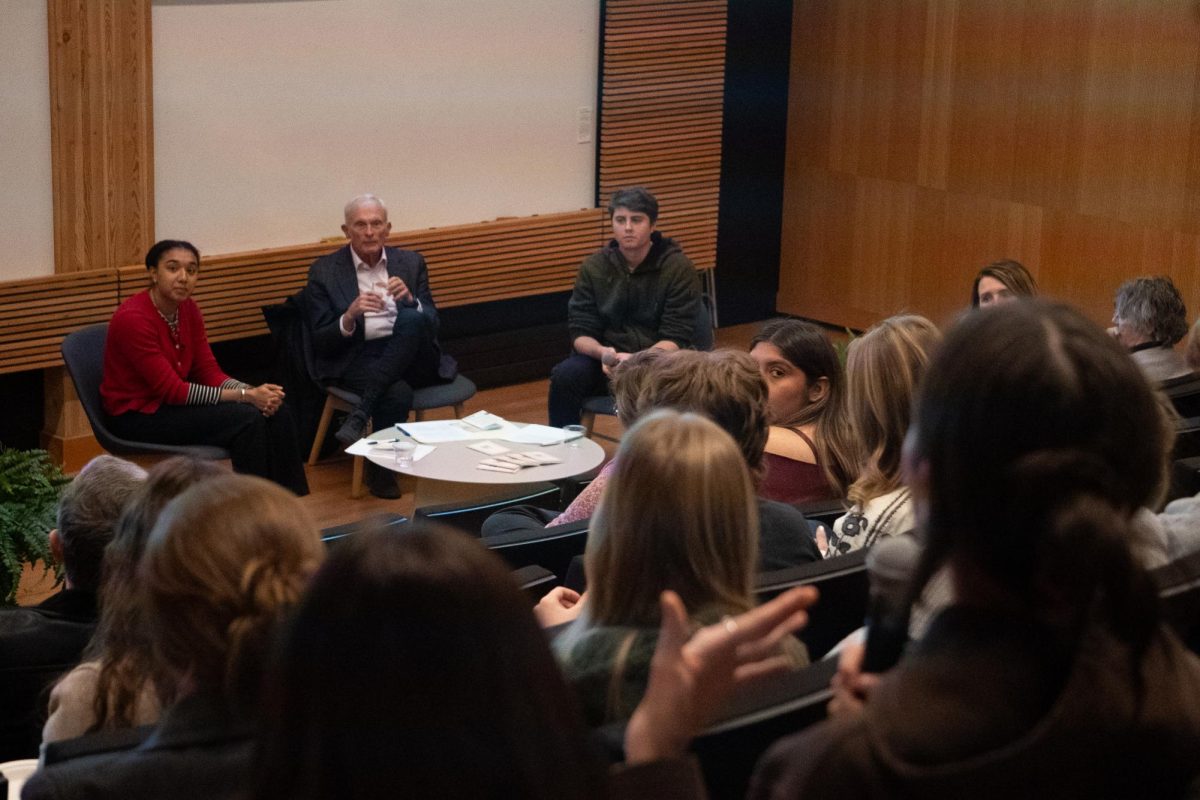
Michael Fischer, professor of English, discussed his fourth published book, “How Books Can Save Democracy,” at an event hosted by “The Conversation.” James Oberwortman, senior political science and marketing double-major, and Iman Zakaria, sophomore biology major, led the discussion in front of more than 50 Trinity community members at Dicke Hall on Jan. 27.
Throughout the event, Fischer spoke about the book’s themes, such as the importance of discussion, collaboration and compromise within democratic systems. He asserted that literature can help people empathize and interact with those around them. All literature, especially on personal experiences, plays a role in strengthening relationships and democracies.
Oberwortman asked Fischer about an argument between two of the book’s characters, who were opposed to each other’s views beyond debate or reason. Oberwortman questioned when it’s right to take a step back and reflect on one’s own views, versus when one should step forward to make those views a reality. Disagreement is the “lifeblood of democracy,” Fischer said, but people must both reflect on their own beliefs and constructively argue in favor of them.
“That’s what I say literature does. It doesn’t eliminate arguments, but as I keep saying, it lowers the temperature so that arguments don’t become a knockdown where only one side can win,” Fischer said.
For over an hour after the event, audience members asked Fischer questions regarding topics such as current politics, sexual identities and AI. In an interview with the Trinitonian, Zakaria said that having these conversations and seeing others invested in them is important for opening doors and people’s hearts.
“This will be maybe a kickstart or a springboard to push people and have momentum to have more conversations,” Zakaria said.
Democracies are always in need of saving, Fischer said during and after the event. They must always be trying to expand participation through debate and ideas. Books help people understand others’ feelings, he shared, which minimizes the tendency to stigmatize and dehumanize outgroups.