
“I would apply but literally everyone I know who works for the Trinitonian hates it”
– Anonymous Fizz poster
And yes, I took it personally. I know the person who made the original Fizz post probably didn’t intend to cause me to spiral, yet here we are. As managing editor, it’s my job to make sure that the Trinitonian’s writers, editors and artists don’t hate their jobs. I try every day to make sure I’m doing my job as a manager and that my people are okay.
When someone says they hate their job, it feels like a criticism of my performance, or worse, an indictment of how I treat others. Truth be told, I complain about hating my job and quitting once a week. The Trinitonian feels like more work than I signed up for as a first-year looking for extra cash and a community.
But then I remembered something: people don’t complain about things they don’t care about, they just leave. And the proof is right there in the original post: “everyone I know who works….” Works. Present tense. They’re still here. I’m still here. And I know exactly why.
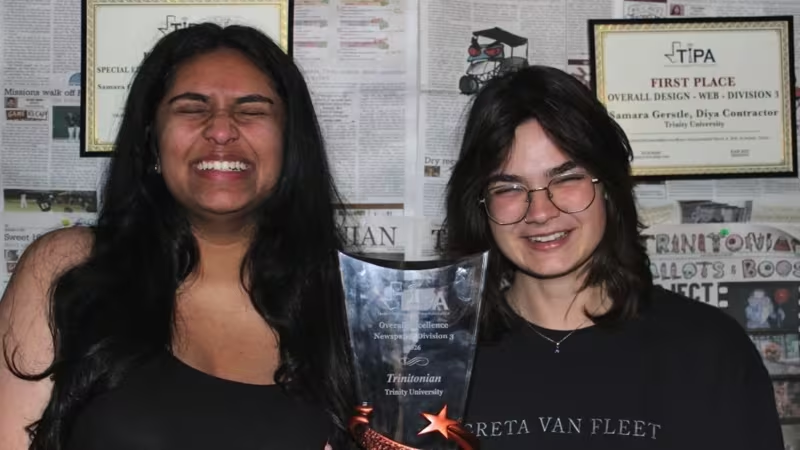
I’m still here because I remember when we spent hours writing and re-writing the original red zone piece, laughing the whole time. Or when our Fizz coverage actually changed how people used that app. I’m still here because professors have come up to both Editor-in-Chief Samara Gerstle and me to tell us that the work we’ve been doing is invaluable.
I’m still here, because when a story finally works, when a writer submits a perfect lede or a wonderfully enticing hook, there’s no feeling like it. I’m here for the moments when I look up at 11:00 p.m, and everyone is still in the newsroom, still trying — still caring — about getting it right. When it all comes together like that, nothing else matters. Not the exhaustion, not the stress, not the anonymous Fizz posts. Just the work, and the fact that it’s worth being proud of.
Sometimes, I know that our journalists look miserable. I know well the blank stares, the frantic typing of an editorial when Sam and I don’t have time to write it in advance, the paralyzing fear that hits when our Macs’ loading sign replaces the cursor, and everyone begins praying that it won’t crash. From the outside, it probably looks like a room full of people questioning every life choice that led them here.
But that misery isn’t apathy. And I know this for a fact, because I know we don’t pay our editors enough to keep them here if they hate their jobs. It’s the kind of misery that shows up when you’re deeply invested in something — when you want a story to be good, your edits to be fair. When you want your section to be the best or when you want to prove to yourself that you can do this. It’s the frustration of caring so much that it physically manifests itself as caffeine shakes and the occasional forehead pressed dramatically against a desk.
I know that what looks like burnout from the outside is really just commitment wearing a slightly unhinged expression. It’s the kind of commitment that keeps people at the office long after their responsibilities are completed, that makes them argue passionately about whether or not a sentence is “clunky.” It’s messy, chaotic and occasionally ridiculous. It’s also the clearest sign that we’re not phoning it in. We’re trying. We’re invested. And every week, everyone shows up: tired, stressed and occasionally feral.
That’s what “Anonymous” on Fizz missed. No one works for the Trinitonian because it’s easy or for the money. Neither of those things are enough. They work with us because they know it matters. Because telling the truth matters. Because holding power accountable matters. Because being part of something bigger than yourself matters.
Journalism is a dying industry. Social media has done a fantastic job replacing hard-hitting, accurate reporting with rage-baiting rumors dressed up in a Canva template. Newsrooms are shuttering, local papers are vanishing and the people who are supposed to ask the hard questions are disappearing. But that’s exactly why we can’t afford to stop — because the need for accountability doesn’t die when the industry starts to. Someone still has to dig for the truth when it’s inconvenient, still has to verify sources when it’s easier to post first and fact-check never. Knowing that we’re doing the hard work makes it all worth it.
And if you join us on staff, you’ll be part of that too. There’s nothing quite like seeing your first byline in print, or saving newspaper clippings like you’re a 90s detective or seeing a stranger’s positive comment on a story. As a part of the Trinitonian, you’ll get to ask the questions no one else is asking and refuse to let important stories die in silence.
Because the Trinitonian isn’t just a job or a résumé boost. It’s a community. It’s Trinity’s only journalism program, and it teaches more about resilience and responsibility than any “real workplace” ever could.
So if you’re thinking about applying, don’t let “Anonymous” scare you off. Set up an interview, and talk to me or Sam. We’ll tell you why a group of exhausted, overcaffeinated students pour their whole hearts into something that will be recycled in a week but remembered for much longer. We don’t hate it here. We love it — fiercely, stupidly and wholeheartedly. And that’s why we stay, especially when it’s hard.
*This column was updated on Feb. 4, 2026.

Anonymous • Feb 11, 2026 at 2:38 pm
my friend works for the trinitonian and they always tell me about the very negative toll it takes on their mental health. i like to write but never thought about applying.. many people i know feel similarly