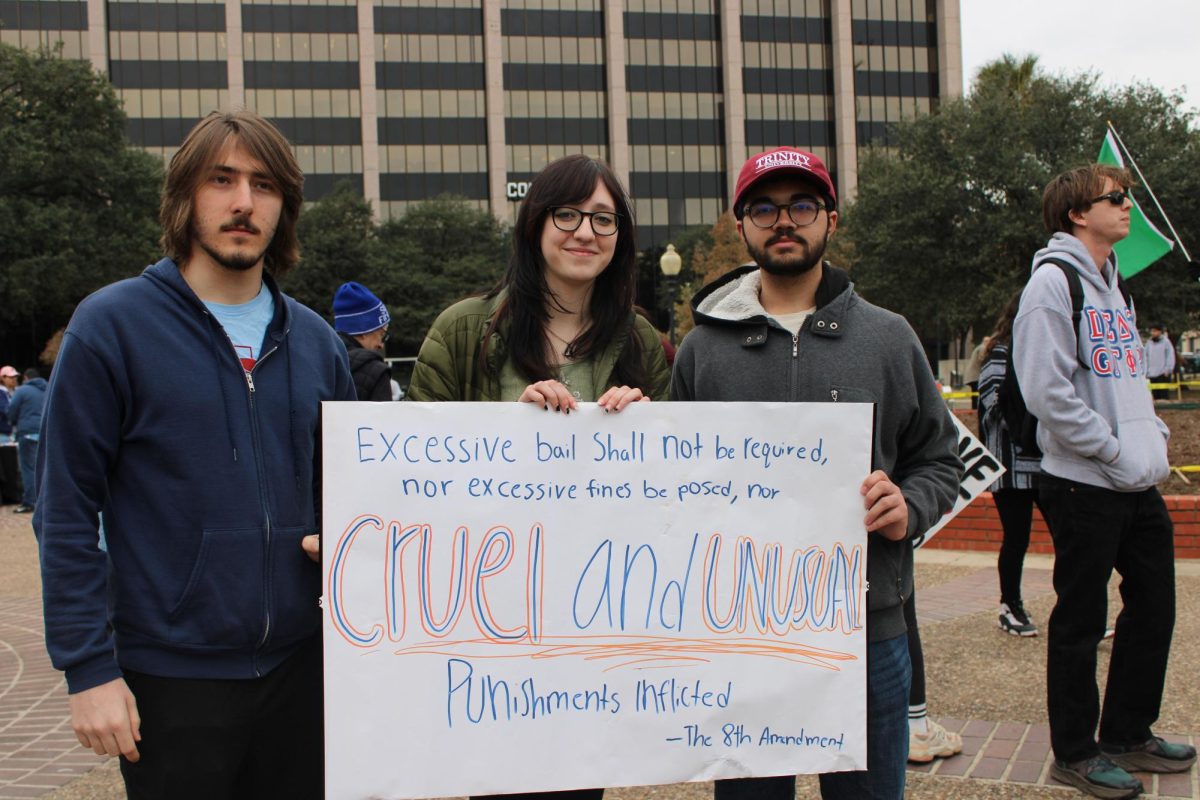
Trinity students joined hundreds of protesters gathered in Travis Park and marched through downtown San Antonio on Jan. 30 to protest against Immigration and Customs Enforcement (ICE) as part of a national economic shutdown.
The event began in Travis Park with speakers from the Democratic Socialists of America, the Palestinian Youth Movement and the protest organizer Party for Socialism and Liberation (PSL). The speakers gave calls to action against ICE activity and the Trump administration. Speakers also laid blame on the Democratic Party for enabling ICE through inaction.
After about an hour in Travis Park, the San Antonio Police Department escorted protesters through downtown San Antonio. Protestors chanted “No justice, no peace, no ICE in our streets!” and “Whose streets? Our streets!” as they marched. During the march, PSL officials said the crowd swelled to over 1,000.
Many Trinity students were in attendance. Cole Robinson, sophomore undecided major, said that there is power in numbers. He hopes the protest shows people they are not alone and that millions of people in the U.S. feel this outrage.
“People are afraid, but we’re also angry. We’re really angry, and I think there’s no better way to funnel it than showing up and being with a community,” Robinson said. “It’s being here, the catharsis of saying, ‘I’m not alone in feeling this way.’”
Benjamin Castaño, first-year applied physics major, was also in attendance at the protest. He said that the U.S. is the “mixing pot of the world,” and that it is fueled by people of different genders, sexualities, religions and cultures. He expressed sadness that this version of the United States is being taken from his generation and believes protecting it is important.
“So even though this small group of people won’t change that much, the fact that we’re all doing it at the same time sends a message,” Castaño said. “And it might end up falling on deaf ears in the government, but it shows that we truly care.”
Sofia Ko, first-year engineering major, was motivated to come to the protest because of the families that have been “ripped apart” due to ICE deportations. She is from an immigrant family, like many of her friends, she said.
“I think it’s me being worried for my friends and just everyone who’s not been able to be with their family,” Ko said. “I know my friend, she can’t see her family, they can’t even come into America. And that’s really hard on her.”
Amanda Evans, first-year neuroscience major, attended the protest because ICE is out of control, she said. She has a friend from Houston whose father was deported by ICE, and although she hasn’t spoken to her friend lately, she is sure it is devastating for her, Evans said.
“They’ve already killed nine people this month, and just in general, I don’t agree with what they stand for. And they just need to be abolished,” Evans said.
PSL member and protest organizer Destiney Peña, 37, told the Trinitonian that she planned the protest because she was upset about “ICE terror” occurring not just in San Antonio, but across the U.S. As an organizer, she said she has never seen nationwide momentum like this before.
“I think now, as working class people, we’re getting organized, and we’re learning how to fight back,” Peña said. “We want power, and we’re gonna take power.”
Even if people couldn’t participate in the protest on Jan. 30, they should continue to pay attention and not sit on the sidelines, Peña said. There is a community of people outraged by ICE’s actions, and everyone needs to get in motion and “join the masses.”
The protest in San Antonio follows the call for a national shutdown following the success of Minneapolis’s strike on Jan. 23, as well as the killing of Alex Pretti on Jan. 24. Major cities across the country also saw large protests drawing thousands in a national protest against ICE. ICE’s presence across the U.S. has ramped up in recent months, and on Feb. 3, ICE purchased a warehouse about six and a half miles away from Trinity’s campus. ICE internal documents obtained by the Dallas Morning News state that the warehouse will be converted into a processing center where detainees will first be taken before transferring to a detention center and ultimately being deported.