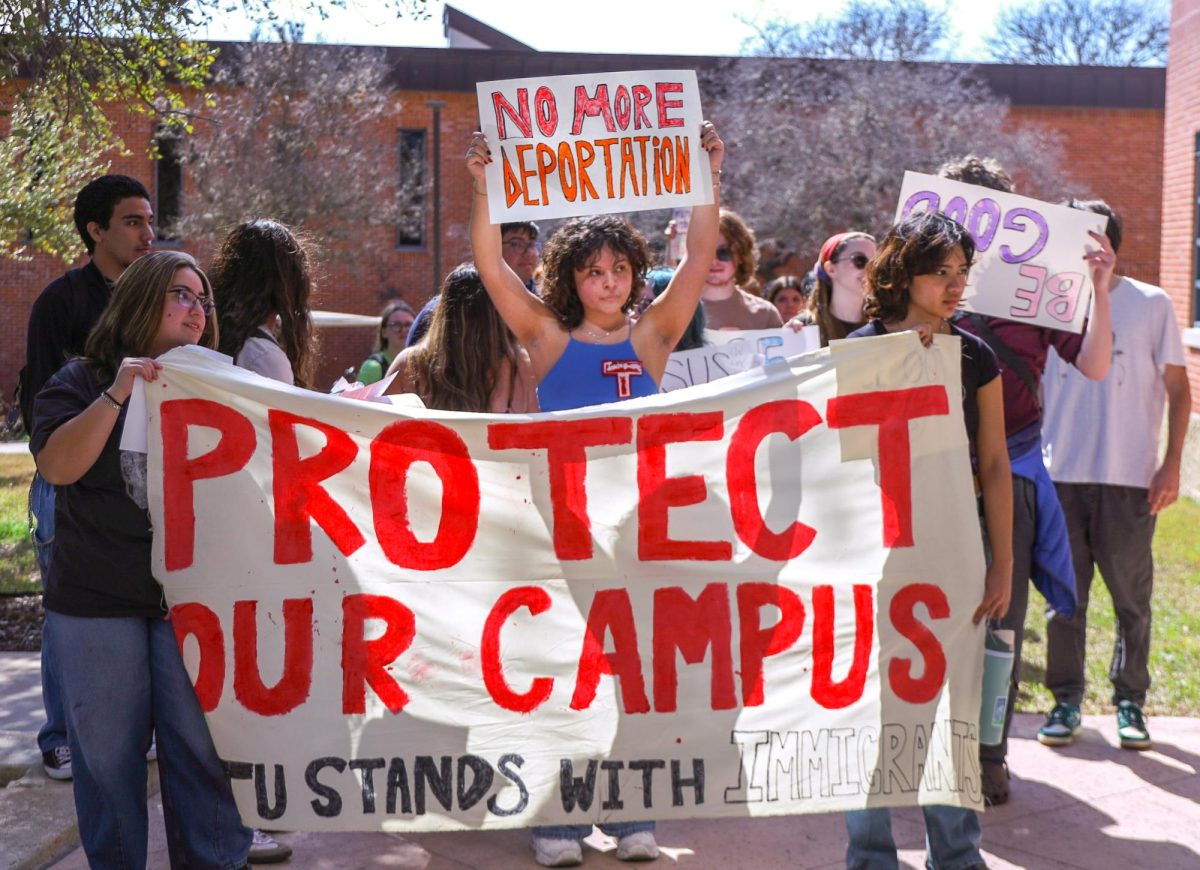
On Feb. 9, a group of over 70 students could be seen carrying signs and heard chanting as they walked from the Magic Stones to President Beasley’s office in Northrup Hall, demanding Trinity administration denounce United States Immigration and Customs Enforcement’s (ICE) potential presence on campus.
Organizers demanded the following, both on their social media accounts and publicly at the event:
- That TUPD not collaborate with ICE
- That ICE not be allowed on Trinity’s campus without judicial warrant
- That all staff members be trained on how to respond if they encounter ICE on campus
- That the administration issue a statement that Trinity is a “safe space for all people, regardless of immigration status”
Trinity Students for Justice in Palestine President Julia Williams*, junior international studies major, and Revolución Violeta President Alynn Jimenez Miranda, junior political science and international studies double-major, began spearheading the protest on Jan. 29.
Williams and Jimenez Miranda, along with a coalition of students from various organizations distributed whistle kits, written chants and flyers printed with the demands. Organizers also spoke at the Magic Stones and marched in protest to President Vanessa Beasley’s office in Northrup Hall. As of 6 p.m. on Feb. 11, the petition had about 212 signatures and counting.
“Let me remind you: You are standing in San Antonio, a city built by immigrants, sustained by the working class and shaped by communities that have been forced to survive despite constant violence from the state,” Kay Cansino, Trinity University Latino Association (TULA) co-president and senior sociology major, told the crowd.
Student organizations that collaborated to put together the event included representatives from Latinas Unidas, TULA, Revolución Violeta, Trinity Students for Justice in Palestine (TSJP), the Black Student Union (BSU) and PRIDE. Trinity’s silence on recent ICE arrests and detentions in the San Antonio area and the country inspired the coalition, Jimenez Miranda said.
“That’s something that, as college students, has started to concern us. Not because we’re seeing ICE around campus or inside our campus, but because we haven’t received any answers from our school,” Jimenez Miranda said in an interview.
Cansino, one of the speakers at the protest, is a San Antonio native from an immigrant family. Part of her decision to speak derived from seeing ICE in her neighborhood, and she was motivated to inform Trinity students about ICE’s impact on San Antonio due to what she called the “Trinity bubble.” Since most students live on campus, they are not typically exposed to the neighborhoods across the city affected by ICE, she said.
“Students have a lot of power if they use it correctly, if they educate themselves, if they put that into action,” Cansino said. “My biggest ask of the community is to just care, to have empathy.”
One of the attendees of the event, Gweiling Brandt, sophomore political science and sociology double-major, expressed a similar sentiment — marching to urge Trinity administration to take a stance on ICE. “I feel like you can be in a hopeless situation when you’re just sitting there, bed-rotting and doing nothing,” Brandt said.
Around three hours after the teach-in ended, Beasley wrote an email to the Trinity community outlining the administration’s plans to handle ICE, should they come to campus. Beasley wrote that if ICE were on Trinity’s campus, they would be treated the same as other law enforcement agencies and expected to follow proper laws and constitutional protections. ICE would be able to access public areas like outdoor spaces and lobbies, but would not be permitted access to private spaces like classrooms, offices or residence halls without proper legal authorization, according to Beasley. The email was a general response to conversations that have been circulating on campus as a whole, according to Clinton Colmenares, senior director of news and media strategy.
However, this was the “bare minimum” for Jimenez Miranda, and it should have been sent earlier, she said. Due to Trinity’s emphasis on student diversity and inclusion, a walk-out and a teach-in should not have been necessary for administration to issue a statement. She urged administration to devise protocols for ICE coming to campus and train employees on what to do in the situation.
*Julia Williams is the advertising director for the Trinitonian.