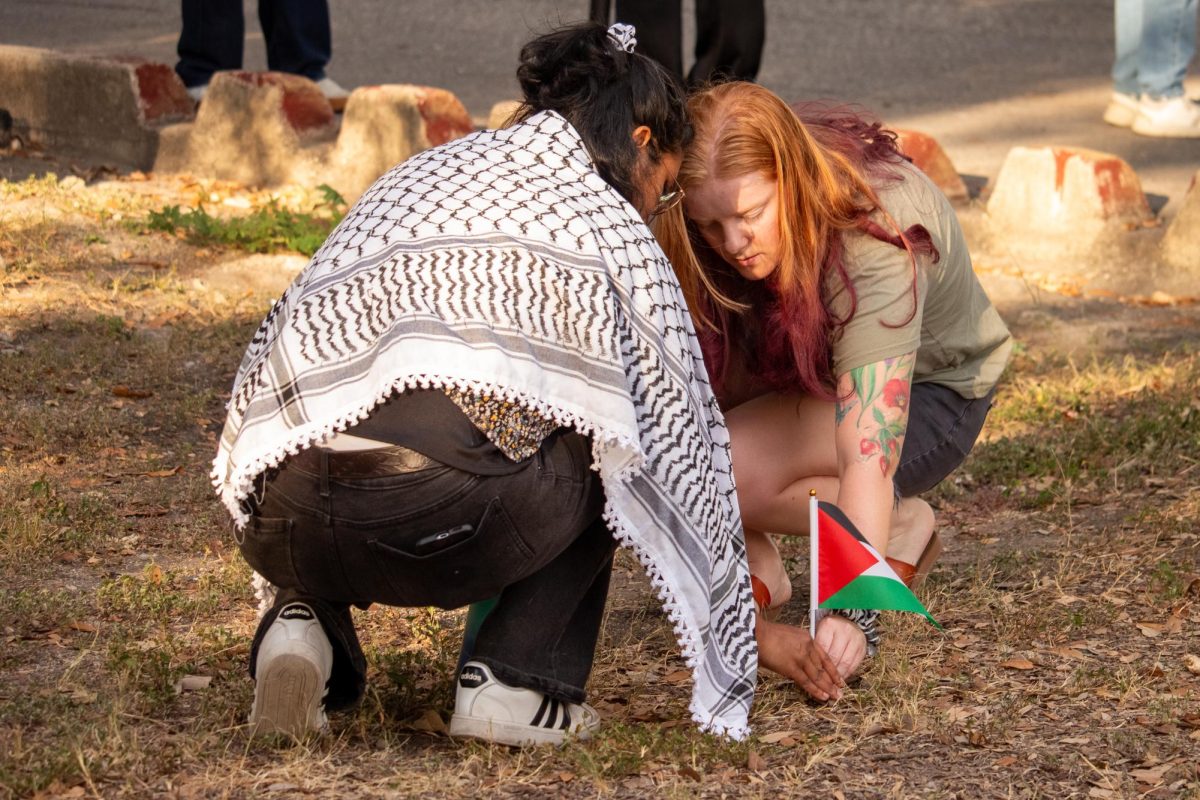
Around 40 students and faculty gathered in Dicke Hall to hear from two professors on the topics of the Israel-Gaza war, Donald Trump’s Board of Peace and women’s rights in Palestine on March 25.
Rosa Aloisi, associate professor of political science, and Sussan Siavoshi, Una Chapman Cox professor of international affairs, spoke at the panel.
Arianna Medina, junior political science and history major, is the social media coordinator of Trinity Students for Justice in Palestine and helped organize the event. She explained why the topics were chosen for the event and spoke about their importance.
“We were thinking about what topics people wanted to hear about, something that our professors were looking into and were experts in,” Medina said. “I think one of the biggest things is just staying informed, at least trying to stay informed.”
The Trinity Students for Justice in Palestine additionally gave a statement on the goals and desires for planning and hosting this event.
“The event was focused on critically assessing the so-called Board of Peace and shedding light on the political agency of women in Palestine, in order to allow the Trinity community to engage with topics that are typically kept outside of the classroom. Unfortunately, there is still stigma attached to talking about sociopolitical and humanitarian issues impacting the Middle East and North Africa. Our hope with this event was to fight against this stigma and provide a space for students, staff, and faculty to interact with questions that are usually frowned upon.”
Aloisi mainly spoke on the current ceasefire. The general conversation surrounded the legitimacy of the ceasefire as well as the controversial Board of Peace established by the Trump administration regarding it. Among the topics discussed was the fact that there lacks a specific definition in international law of what exactly constitutes a ceasefire, how that has allowed violations to occur and the Board of Peace lacking any Palestinian input. She also shed light on how it seems that the media spotlight on Gaza has “faded” overall in the last several months.
Siavoshi led the discussion on the topic of Palestinian women. She spoke about how aspects of women’s lives are threatened in Gaza, especially in terms of reproductive problems. She cited the lack of medical care, aid, food and water. Other topics included Palestine’s modern history, the impact of the 1917 Balfour Declaration on dividing the region and women’ s roles in armed and unarmed resistance. The topic of “resilience” amongst the women of Gaza was prevalent, as “war is not just fought on the battlefield,” Siavoshi said.
The floor opened up to audience questions and discussion after the lectures, which included questions such as “Has there been a shift in Palestinian women’s agency since Oct. 7, 2023?” Siavoshi responded by saying that none had really occurred in Palestine itself but mentioned a “flurry of activities in the Arab world” which involved authors, writers and other intellectuals.
Jayme Reyna, first-year political science major, was in attendance at the event. He was motivated to attend by personal convictions regarding the subject matter and a desire to further educate himself.
“This is about being human in general. We’ve already had this repeated in history, numerous times before in Africa, in Asia, in Mexico where my family comes from,” said Reyna. “We need to stop this settler colonialism from happening. It’s got to stop, and I want to be part of that change.”
The event ended with applause and further discussions among smaller groups.