

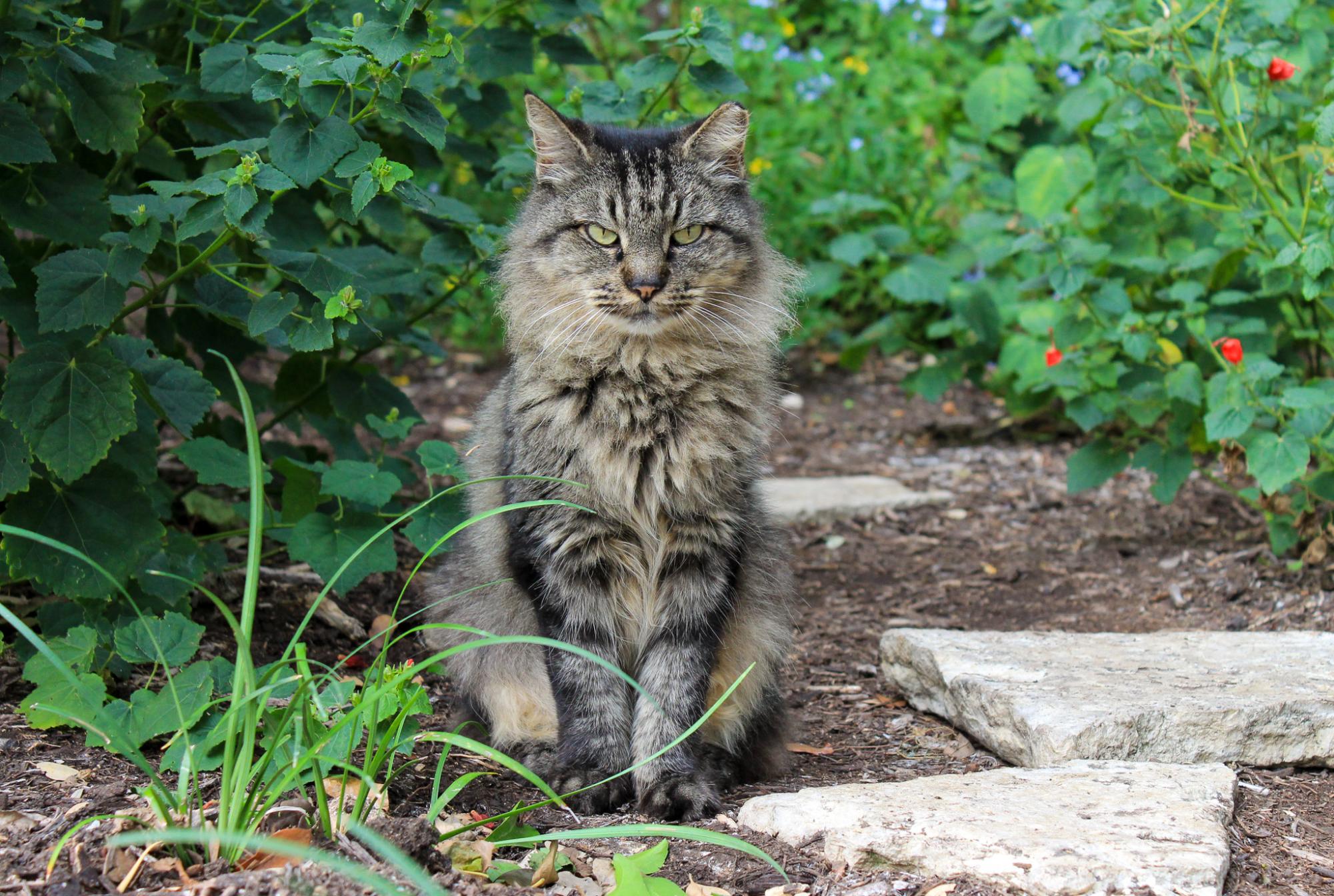
When I first toured Trinity before committing to the school, watching the Trinicats saunter around campus was an adorable sight. Among the beautiful trees, bushes and flowers, majestic felines only added to the scenic landscape. But as cute as they were, I couldn’t help but think that cats shouldn’t live outside. I love the Trinicats as much as the next person, but I love the idea of cats staying indoors a whole lot more.
Outdoor cats have an astronomically negative impact on biodiversity. The Texas A&M College of Veterinary and Biomedical Sciences estimates that free-roaming cats kill as many as 4 billion birds, 22.3 billion mammals and 1.1 billion amphibians and reptiles each year in the U.S. alone. They’re highly invasive and have contributed to the extinction of 63 species.
Of course, the Trinicats alone aren’t responsible for all of these deaths, but they have certainly squashed countless critters on Trinity’s campus. Cats are natural-born hunters, and I’ve seen them kill countless birds and lizards on campus out of instinct. While the cats aren’t at fault for following their built-in predatory drive, humans are certainly at fault for giving them ample opportunity to squash biodiversity for no real reason.
The Cat Alliance Trinity (CAT) implements trap-neuter-return (TNR) protocols to ensure Trinicats cannot reproduce and keep feral cat populations under control. Unfortunately, TNR isn’t a perfect solution. Neutering a cat will prevent it from reproducing, but in order to keep a feral cat colony under control, you would need to sterilize a minimum of 70% of cats in a colony — an often unachievable proportion. With smaller cat colonies, like the one on campus, this rate may be possible, but TNR still doesn’t address negative impacts on biodiversity. Neutering cats does not prevent them from hunting for sport.
TNR does not prevent well-intentioned yet irresponsible community members from abandoning cats on campus and hoping someone at Trinity will figure out how to rehome them, either. A domesticated cat called Witt was almost certainly abandoned at Trinity in 2019 along with six others of unknown origins. While CAT was able to place him in a new home, our campus should not be somewhere people feel they can dump their cats and leave. We need to be educating cat owners on best practices rather than showing them Trinity will deal with their pets for them. I don’t mean to single out CAT here — cat owners everywhere who let their pets roam freely outdoors or dump them in feral cat colonies are part of the problem. People who maintain feral cat colonies without efforts to mitigate them are part of the problem.
I love cats and care for their well-being. While I have no doubt that members of CAT and others who allow their cats outside feel the same way, keeping cats indoors is far better for their own safety. Outdoor cats have a life expectancy of 2-5 years, while indoor cats often live for 12-15 on average. This sizable difference is because outdoor cats are susceptible to poisoning, predators or vehicular accidents. About 5.4 million cats get hit by cars in the U.S. each year, and 97% of them die from their injuries. On our own campus, Trinicat Flora died after a golf cart struck her this last October. These deaths are preventable. Cats can live much longer and safer lives when they are indoors and protected by their loving owners.
However, I’m not saying to take a Trinicat indoors. Nobody at this school permanently lives here, and there’s always a chance that a Trinicat gets stuck indoors with nobody there to let them out over long breaks. These cats have no true owner, and taking half-hearted responsibility for them by giving them a bath in your dorm room and going off to class is not a good idea.
Plus, many Trinicats would not be happy indoors. Some of them are feral and cannot successfully be placed in indoor homes. They are too untrusting of humans and too used to a life outdoors. CAT provides a consistent food and water source for these felines and implements TNR to ensure they can’t reproduce. These are all true statements, and while I am not advocating that we stop caring for the existing animals, well-intentioned community members and programs like CAT should shift their focus to promoting responsible cat-owning rather than pushing the image that outdoor cats are to be celebrated.
We should not be letting new Trinicats onto our campus. We should be adopting them out or surrendering them to local shelters who can find placements if nobody on campus can.
Feeding unowned urban cats — neutered or not — spreads an implied message that cats have a place outdoors. This is simply not true. The costs to biodiversity and overall feline safety far outweigh the benefits of having free-roaming cats, on campus and beyond.
Next time you stroll past a dead bird on the sidewalk, Colby Jack holding a lizard hostage or a cautious golf cart driver nervously swerving around Fauna, think twice before going about your day. We don’t have to let cats dictate biodiversity on our campus, and we don’t have to put them in harm’s way. Promote responsible cat ownership and don’t allow more wild cats onto our campus.





MARK WOODWARD • Apr 30, 2026 at 5:17 pm
Absolutely!
There is so much harm caused by unowned cats people feed from habitat destruction to attracting large predators to making neighborhoods unlivable, public health threats let along it’s cruel to the cats who slowly die of parasites and diseases.
The best any city wide TNR program can achieve is a 4% neuter rate of the feral cats being fed city wide. The feeding that is part of TNR actually increases populations until the limiting factors of disease and parasites, coyotes and car strikes finds an equilibrium.
Cat feeding close together from contaminated bowls in filthy disease-parasite rich environment quickly get infected, infested and start their 3 year painful decline to death. That is cruelty but done for emotional needs of feral cat hobbyists.
Plan • May 1, 2026 at 8:00 am
Not a word of this is true. There isn’t a single study that claims TNR can reach 4% maximum spay/neuter. In fact, the D.C. Cat Count, to date the ONLY comprehensive effort to actually count the number of cats within a defined area, found more than 90% of cats were accounted for either as pets or as members of managed TNR colonies, and the predatory impact was far lower than studies estimate because cats simply don’t do much damage to biodiversity unless they’re within close range of wooded areas. On average, cats range a maximum of a few hundred feet from their home, whether “home” is a house or a colony.
Additionally, even a cursory look at studies claiming massive feline impact on biodiversity shows those are not studies, but meta-analyses that rely on outdated studies that have nothing to do with predatory impact.
Don’t take my word for it. Read the studies. It’s appalling what passes for scholarship in this area, and the credulity with which these studies are treated in the press. Anyone who submitted studies like that in the hard sciences would be laughed out of the field, but somehow it’s acceptable to invent numbers when it comes to “studies” about feline predatory impact.
Again, don’t take my word for it. Read the studies, read the reactions from wider scientific community.
If we’re going to make policy, we’re going to need real data, not meta-analyses of decades-old studies that have nothing to do with predatory impact in the first place.
Linda • May 6, 2026 at 8:28 pm
TNR doesn’t reduce the population of feral cats. For any reduction via TNR, more than 70% of the fertile population of cats must be fixed annually within an area like a zip code or city, not a colony here or there. Anything less and folks are spinning their wheels.
As for cats not doing much damage to biodiversity. What degree of damage is acceptable to you ?
Tell the full story… yeah, 100 meters (328 feet) may not be very far, but enough to do quite a bit of damage, especially given the density of cats. That is key. Regardless, a single cat can extirpate native fauna from a local area.
See the study “The small home ranges and large local ecological impacts of pet cats” published in Animal Conservation in March 2020.
Excerpts of press release…
…hunting by house cats can have big effects on local animal populations because they kill more prey, in a given area, than similar-sized wild predators. This effect is mostly concentrated relatively close to a pet cat’s home, since most of their movement was a 100-meter radius of their homes, usually encompassing a few of their neighborhood’s yards on either side.
The study showed that house cats killed an average of 14.2 to 38.9 prey per 100 acres, or hectare, per year.
The study also showed that cats do much of their damage to wildlife in disturbed habitats, like housing developments.
Because the negative impact of cats is so local, we create a situation in which the positive aspects of wildlife, be they the songs of birds or the beneficial effects of lizards on pests, are least common where we would appreciate them most,” said study co-author Rob Dunn, William Neal Reynolds Distinguished Professor of Applied Ecology at NC State. “Humans find joy in biodiversity, but we have, by letting cats go outdoors, unwittingly engineered a world in which such joys are ever harder to experience.”
You seem to be referring to Loss et al. 2013.
Loss et al. assumed most distributions are uniform, so the question is whether they are reasonable or not . Because they use the uniform distribution, all that matters is the top end and bottom end of the range; the studies are not averaged. They assume that cats kill 1.2 to 3.3 times the number of prey they return. That’s reasonable. Of course the Kitty Cam studies back this up. Whether that range is based on 7 or 8 studies makes no difference.
The Loss et al. paper provides a methodology and others can use that methodology with their own numbers. But those numbers need to be credible. So if someone can come up with some other numbers that are supported by evidence, they can have their own estimates.
We all acknowledge that we don’t know how many feral cats are out there, and Loss et al. therefore give a large range, the low end of which is 30 million, which again, seems reasonable.
The approach is robust. The results have uncertainty, but the sources of that uncertainty are transparent.
Folks who criticize meta-analyses are usually those who just don’t like the results. Meta-analyses should have the following:
• Well-defined objectives, including precise definitions of clinical variables and outcomes
• An appropriate and well-documented study identification and selection strategy
• Evaluation of bias in the identification and selection of studies
• Description and evaluation of heterogeneity
• Justification of data analytic techniques
• Use of sensitivity analysis.
Loss et al. did these things.
TNR is a scourge on the environment, increases risks to public health, and subjects cats to life and death outdoors.