

“We shouldn’t be glorifying outdoor cats” was as much of a surprise to our organization as it was to the rest of campus. Admittedly, the initial reaction was one of anxiety. As the central example of the column, we feared that the criticism of feral cat colonies was also an indication of discontent with our mission and our decades of work as both a student organization and nonprofit. Both our current and rising community outreach officers had the opportunity to speak with the author, outgoing opinion editor Riya Vankamamidi, earlier this week and share some more information about us.
The conversation was friendly, reassuring and, above all, enlightening. It signaled to us that we needed to be more forthcoming with the way that our organization operates so that the truth is impossible to misconstrue: Cat Alliance Trinity is, in many ways, a very specific kind of success story in feral cat population management.
More than anything, we want to make it known that not only do we support the author’s right to speak her mind, but we also agree with her central point. In a perfect world, cats would be able to exclusively live indoors. All of the author’s concerns about the hazards of feral cat life and the subsequent impact on the environment are not only valid but ones that prompt us to fulfill our mission of TNR (Trap-Neuter-Release) in the first place. The goal of every TNR initiative is to mitigate the impact of the feral cat population in the most humane way possible, preventing the birth of new ferals while supporting the lives of those who already exist. It is not our intention to broadcast TNR as the ideal, but to instead show the importance of effort in this cause. Our conversation with the author quickly made it apparent that she intended to use us as a good example of an imperfect and often difficult solution.
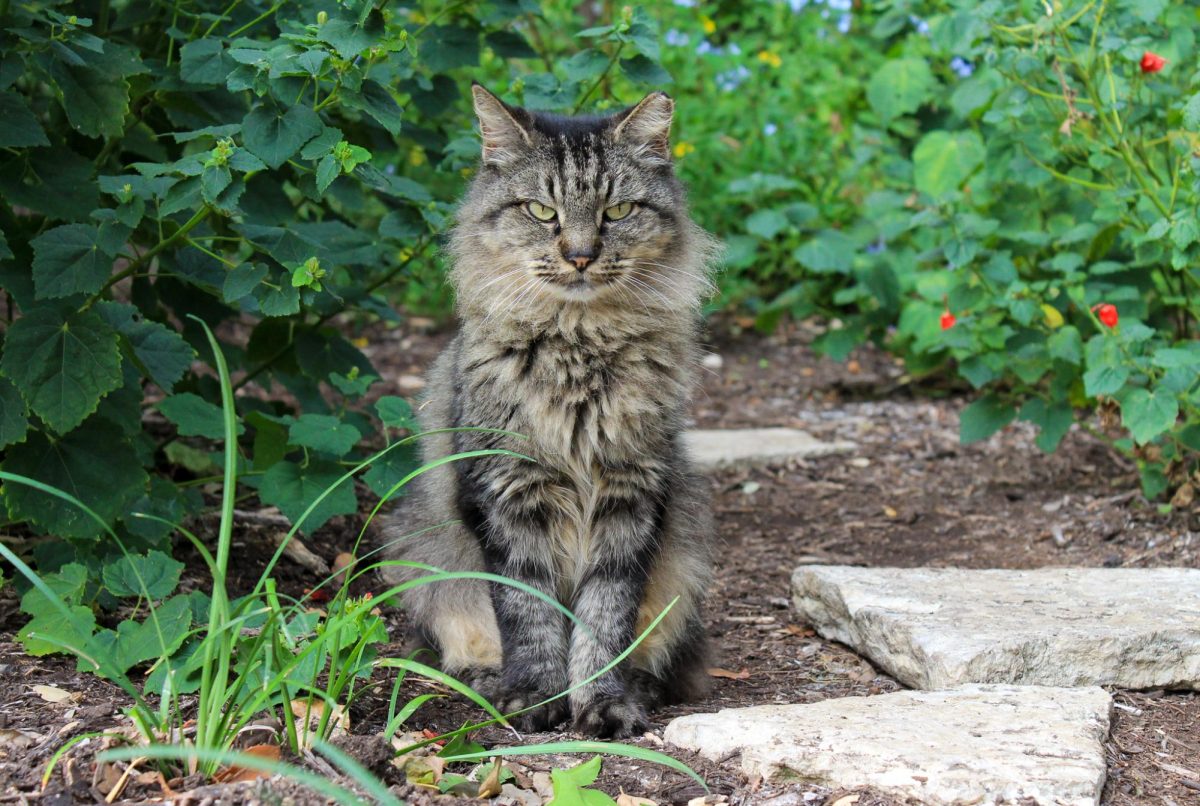
We are so proud of the work we’ve done as an organization. Our present colony is 14 cats, and we have a 100% TNR (and therefore spay/neuter) rate. We have not had an on-campus litter born since 2014, and have succeeded in maintaining our colony to the point that our feral resident population has shrunk by over 75% in 20 years. By our most conservative estimate, over a third of our feline residents are at least 10 years old, and several have surpassed 15 years of age.
However, it is important to note that our success has been facilitated by university collaboration, many animal welfare experts, hundreds of volunteers and the generosity of countless donors. Our founders’ thoughtful planning and our narrow area of focus placed us in a uniquely advantageous position to continue to pursue our mission. We feel so lucky and grateful to have the chance to accomplish what we have. We are so proud of our colony as a small but mighty point in the nationwide effort towards TNR and feral cat population management.
We know and love our community so deeply, and we understand how the opinion column may have caused some worry or frustration. However, at the very heart of it, we all share one common goal: to do what is best for the cats. We have taken the column’s publication as an opportunity to share more about our broader mission, and hope that we can all hear the author out with kindness and an open mind.
Thank you to all that care for us and our mission; we couldn’t do what we do without you. Each and every one of you has helped make our success story possible.
– Freya Sjoqvist, CAT president, Cat Huang, community outreach chair, and Nicole Cintron, campus outreach chair





Linda • May 6, 2026 at 8:48 pm
“The goal of every TNR initiative is to mitigate the impact of the feral cat population in the most humane way possible…”.
Disagree. Initially, decades ago, the goal had been to reduce the population, but TNR neither reduces the number of cats nor population growth. Then the goal changed to colony stabilization or no new kittens born, which is very difficult to achieve.
As the misleadingly-named no-kill movement progressed and shelters continued to be bursting at the seams, the goals changed again to shelter diversion tactics… Return to Field & so-called community cat programs in which friendly felines could also live & die outside.
TNR comes at the expense of wildlife, public health, property rights, and the cats themselves.
14 cats can do a lot of damage… and some are older than 10 or 15. Perhaps now is the time to either re-home them or contain them. If you have the support of the university and hundreds of volunteers, couldn’t a structure/large catio be built so both the cats and wildlife are protected ?