
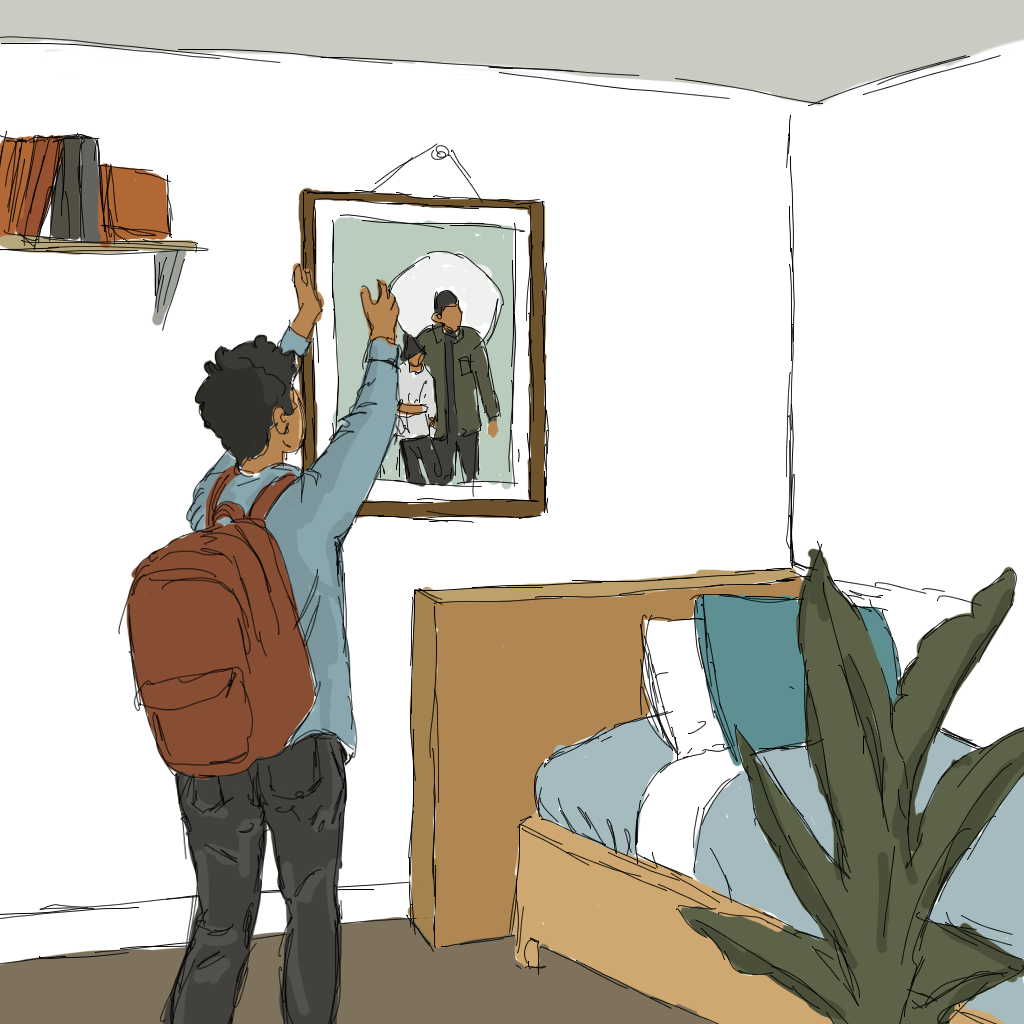
I will never know what it’s like to be a through-and-through American. My birth certificate might say I was born in Boston, and it might be true on paper, but the real ink on my page has always been saffron, green and navy blue. I only truly understood India’s virtues when I turned seven and moved to Bangalore, a sprawling, fast-growing city known as the Silicon Valley of India. Something about the scent of those who are guided by the principles of humility and respect made me feel more connected to my culture than I’d ever been before.
The institution of family is ingrained so deeply into my country’s soul that we wouldn’t exist without it. Right before I was shoved through the door of teenage adolescence, America called my family’s name and back we went. Instantaneously, that credo of familial loyalty crumbled before my eyes and I became an American teenager: embarrassed to hug my mom in public and only willing to call my dad when I needed money.
There’s a culture of disrespect that raises American children, as explained by psychologist Leonard Sax. The movies and television that played every night on Disney portrayed parents as clueless, cruel, irrelevant, absent or just straight-up obstacles on their kids’ path to heroism, love or success (Mulan, Jasmine, Ariel) — so it’s no wonder that American kids who grew up watching these movies and shows are predisposed to hating their parents in their teens.
The rude and rebellious teenager is an inevitable phenomenon here in the States, but in India, when your mom calls, your friends know better than to scream profanity in the background. Teenage rebellion, and its continuance into adulthood, is a Western idea that emerges from individualistic societies. Collectivist societies, such as India and China, focus on family and, more often than not, raise their kids to be respectful.
This isn’t to say non-Western parents are perfect in any way, shape or form — I’m well aware that some immigrant parenting styles have attracted a lot of well-deserved criticism, but there’s something fundamentally flawed about the way American children behave in response to their parents. Whether that’s the fault of parents for not disciplining their kids enough or of kids for not appreciating what their parents sacrifice for them, I don’t know — but it’s something, and it should change. Americans need to treat and speak about their parents more respectfully.
I’m not referring to parents who really should never have become parents, absent parents or careless parents. Instead, I’m referring to parents who are trying their best, and no matter how big the argument is, that fact is irrefutable. We hold our parents to higher standards because it’s their job to coach us and cheer us on from the sidelines, but even the smallest, most rationally forgivable actions (like when mom calls and we’re in class) elicit the most irrational reactions from us. I’ve caught myself stewing in a wave of unwarranted anger when one of my parents makes a mistake I’ve made thousands of times because they’re my parents, and they have to be perfect.
It sucks when parents make mistakes and accidentally hurt us because they’re who we look up to. But as we get closer to the age our parents were when they had us, maybe we can slowly learn to see things from their point of view. Immigrant parents especially, who deal with so much more than will ever be fathomable to their kids, receive the brunt of so much criticism. But as much as immigrant parents compare their kids to their friends’ kids, we do the same right back. Whether implicitly or explicitly, we’ve all wished our parents were more like those of our friends. Is it fair that we hate our parents for doing to us what we do to them?
Immigrant parents are constantly dealing with values they’re unfamiliar with. Adapting to new situations on their own is hard enough, but doing it with a kid who’s kicking and screaming is even harder. Parents are under a lot of pressure to balance being both their kids’ role models and best friends, but these characters often conflict with each other. The metric we judge them by doesn’t account for the fact that they have to discipline us and make us feel comfortable at the same time. Our parents aren’t superheroes, and just as we’re learning, they are too.
I’ve had the privilege of growing up in immigrant communities and enclaves my entire life, so maybe I’m not the most equipped to speak on the topic of truly American families. And from what I’ve experienced through proximity to stereotypical white, Westernized families, I wouldn’t change that for the world. In the words of one of my favorite people ever (Mitski), “Your mother wouldn’t approve of how my mother raised me but I do, I finally do.”
So, all this to say, thank you to my parents. I’m sorry it took me two decades and half my time at college to say it and really mean it, and I’m sorry if I’ve been hard on you. How much you guys have done for me and sacrificed in service of my happiness is insane. As I grow up and become a real person, I swear I’ll work the rest of my life to repay all the love you’ve shown me. I am honored to be your daughter.





Tommy • Jan 2, 2026 at 8:06 am
Good for the writer reaching this mental state. She is, however, still young, 23 maybe, 24? and has not fully grasped the magnitude of how these different styles affect a developing child.
As an immigrant child, I am thankful for being exposed to the Individualistic culture in the US. Without it, I would have never realized and seen the toxicity that can stem from “family” culture that is often hidden and swept under the rug for the sake of family showing face.
I hold people accountable, whether blood-related or not. I don’t praise my parents for doing their job as parents. And I certainly don’t kiss the ground they walk on because they “sacrificed”.
I give my parents a 6/10, which is a fair grade. Slightly above average but not exceptional in any way. Yes, I acknowledge they tried their best, but realistically, most people on the planet are “trying their best”. So no, they don’t get credit for that.
The metric they are being judged on is attentiveness, emotional reinforcement vs neglect, abuse, and psychological manipulation.
All this to say this article is one-dimensional and doesn’t fully capture the nuance of family culture and the confusion of immigrant parents and children.
Diya Contractor • Jan 24, 2026 at 12:59 pm
Hi there! I’m Diya, the original author of this piece. Thank you for taking the time to read and respond to what I’ve written. I’m always immensely appreciative of all feedback I get, critical or not.
I understand where you’re coming from. Generational trauma and cultural norms can absolutely lead to toxic behavior being swept under the rug, and I’ve experienced that too.
That said, the point of what I wrote was to remind us to treat our parents with grace. Yes, sometimes they fail — don’t we all? My point here is that yes, it’s my first time being a daughter, but it’s also their first time being parents. We could all stand to be a little nicer to everyone, whether or not they’re family.
I’m not saying every parent deserves praise; I explicitly excluded abusive and neglectful parents from this conversation. But for those of us whose parents are showing up, even imperfectly, maybe we can meet them halfway, and treat them with the respect everyone is entitled to.
This piece was centered around my own experience, and I recognize it may be different for everyone. What I want people to take away is that we sometimes hold our parents to impossibly high standards. We get irrationally angry when they make small mistakes we’d easily forgive in anyone else. We extend patience to our friends, but our parents don’t always get that same grace.
For immigrant parents especially, we’re asking them to navigate values they were never raised with. If we met someone who didn’t speak English well, we’d be patient. But our parents were raised in completely different societies, and instead of showing them patience, we often just yell. Imagine if someone challenged a belief you’ve held your whole life — wouldn’t you want understanding instead of immediate anger?
I appreciate you sharing your perspective. Everyone’s experience with their parents is different, and I recognize mine is specific to my own relationship. I hope you’ve found peace with your situation. For readers whose experiences align more closely with mine, I hope this piece offered something meaningful.
V • Aug 18, 2024 at 2:31 pm
Amazingly articulated, very well thought and great choice of words. Passing on to my teenager; hope she reads it !!
VRK • Jun 16, 2024 at 10:06 am
Nicely expressed. We as immigrant parents can associate and relate to the facts. We will keep persuing and aspiring that the younger generation recognize this.
As always we love our kids wholeheartedly ❤️
Anitaa Ramesh • May 13, 2024 at 2:17 am
Emotionally blend write up, proud to see you understanding our parents, truly inspiring others
Dipika Contractor • May 12, 2024 at 9:37 pm
We are and always be very proud of you!