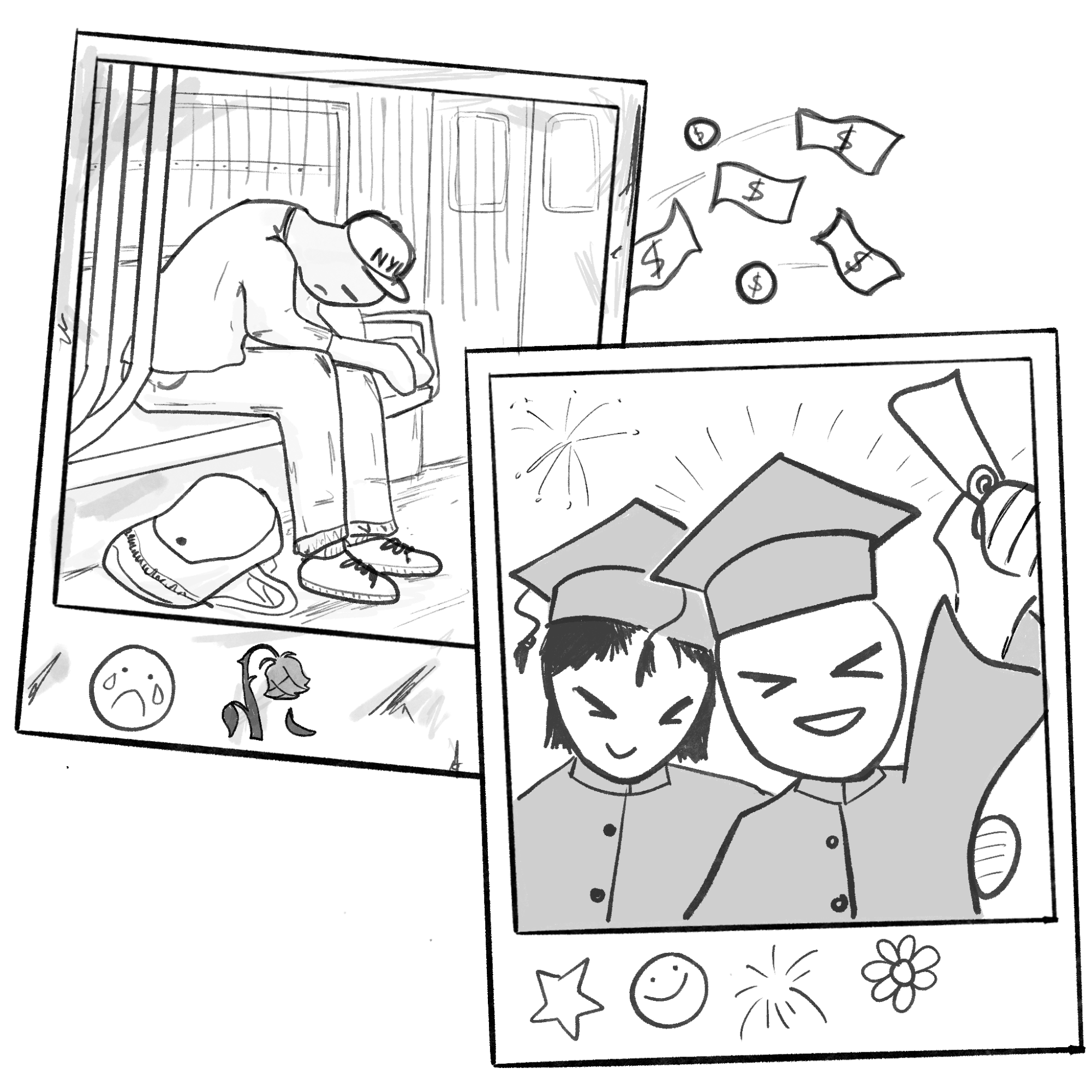
It was neither general education nor “underwater basket weaving,” so I admit that I was a little shocked to see nearly 150 students crowd an aging lecture hall at New York University (NYU) for a course on human rights. But as I sat with my peers, some of whom fell asleep during the lecture, I was confronted with an endemic problem in higher education: Dissatisfaction is the norm. For $60,000 a year without room and board, I expected more than watching students sleep through lectures delivered by chronically overworked adjunct professors. Although I remain a student at NYU, my experience since beginning my visit to Trinity has shown me that the norm is different here, and that real academic distinction isn’t found in “name-brand” prestige — it’s built where learning feels personal, not transactional.
Despite my disappointment, I understood why my classmates were in lower Manhattan with me that night. NYU’s pitch isn’t about intimate classroom discussions. It’s about the proximity to Wall Street, Broadway and the social capital that comes with an address in Manhattan. For over $90,000 a year with housing, students aren’t just buying an education; they’re buying access.
But access is hardly what many prospective students expect from their undergraduate experiences. The pitch at NYU seems to be that you will likely graduate with $300,000–$400,000 in student debt, but you will have studied in an “important” city at a highly selective, “prestigious” university. For too many Americans, higher education has become a real estate transaction disguised as intellectual development.
With so much distance between students’ expectations and what they often receive, public polling confirms that they are largely dissatisfied. A March 2025 Gallup poll revealed that only 18% of current or prospective college students believe four-year colleges charge fair prices for what they offer students.
For some, proximity to various forms of capital and the promise of a conspicuously prestigious degree is enough to justify such an expensive experience in a highly impersonal environment — that’s their choice to make. But it wasn’t right for me. When I came to Trinity as a visiting student last semester, I felt it delivered a more fulfilling undergraduate experience than I received in New York. The class sizes were much smaller, it felt like a true community and I wasn’t chronically disappointed.
Most importantly, the faculty at Trinity are genuinely accessible. In an anthropology course I took last semester, our professor invited the entire class to his house for dinner. He knew each of our names and general interests, making class discussions far more engaging, and we built on ideas formed in dialogue from week to week. His efforts spoke to the levels of connection possible at smaller institutions like Trinity.
When I spoke with Jacob Newell, senior classical languages major, I found that this experience wasn’t specific to Trinity’s anthropology department.
“We would all stay together after class, even the professor, and just talk and gossip,” Newell said about a Greek course he took last spring. “They have always been open and kind, and you know, you can talk to them about anything.”
A critique of Trinity’s size that I’ve often heard from students concerns its social landscape – that it can feel more analogous to a high school at times than a university. “That can be a good thing and a bad thing. You know a lot about other people’s business,” Newell said.
However, the small class sizes don’t confine Newell to a particular group. “I’ve interacted with people of all different types,” Newell said. “Kids in fraternities and sororities, and then people who are more academically focused or athletically focused.”
Having experienced both environments, I know my choice. Where Trinity attempts to deliver on the promises of a classic liberal arts education, it largely succeeds. Trinity graduates are more likely to find employment and get accepted into graduate programs than many at larger institutions. 98% of Trinity graduates were employed or accepted to graduate programs within six months of receiving their degree in 2022, while NYU’s percentage was lower at 93.6% the same year.
Like many students across the two institutions, I still think tuition costs at both Trinity and NYU are unreasonably expensive. But what Trinity might lack in proximity to capital, it makes up for in experiences and outcomes. Learning in a classroom with 10-15 students will almost always beat a lecture hall with 100. At Trinity, such classes are the norm, not the exception. Here, I don’t feel like I’m paying for mere proximity to success: I’m actually experiencing it.