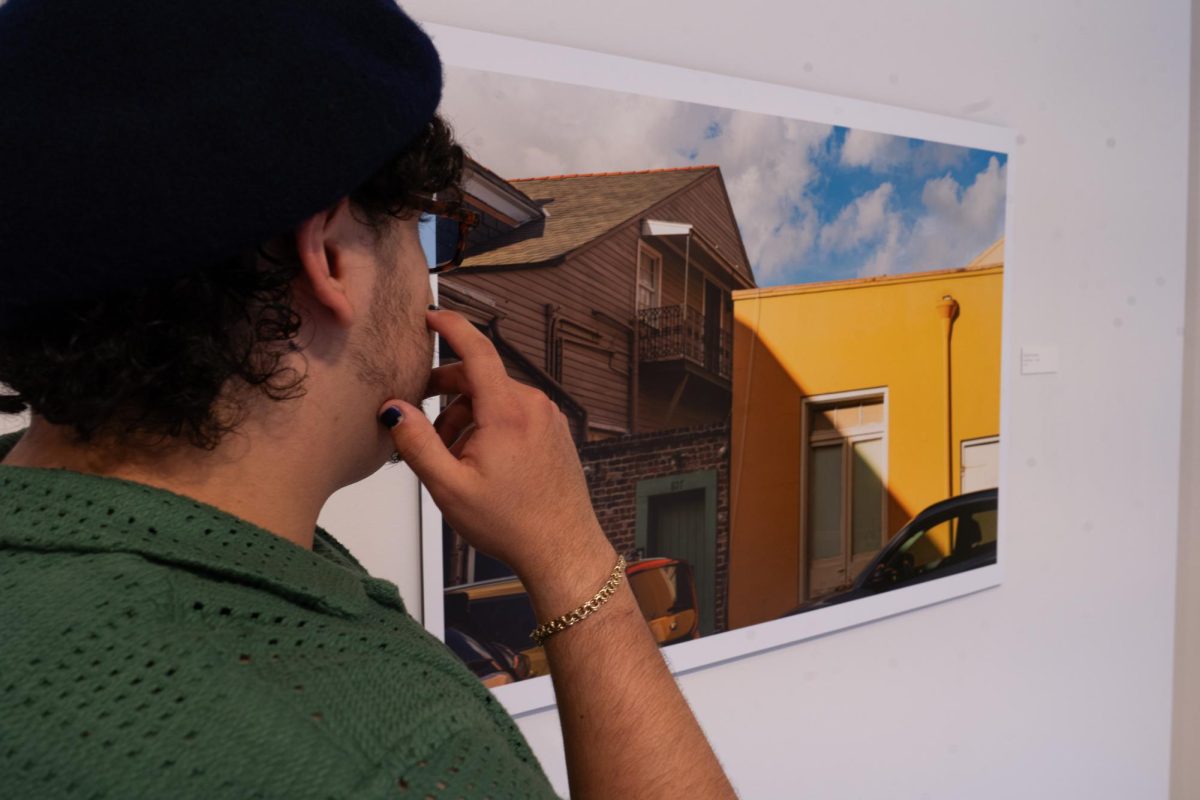
“Creando Nuestros Espacios” opened at the Michael and Noémi Neidorff Gallery inside the Dicke-Smith Building on Sept. 4, but its roots stretch back nearly half a century. The exhibit features works by Latine Trinity alumni who, from the ‘70s to the ‘80s, formed an artistic collective active on campus and in the broader San Antonio community.
The exhibit is part of Conmemorando a la Comunidad, an interdisciplinary archival project started in the spring of 2023 by Dania E. Abreu-Torres, director of Mexico, the Americas and Spain (MAS) special interest program, in collaboration with Abra Schnur, Trinity archivist. “Creando Nuestros Espacios” uses archival materials, histories and donated works to showcase Latine artistry at Trinity.
“We focused on interdisciplinary programming and student organizations in the first year. The second year is when we began to focus on the artists, and Marina [Oquendo] came on as a student researcher to synthesize everything that we were discovering in the archives,” Schnur said. “At the same time, we were connecting oral history interviews of the artists that we had been in contact with to learn more about their experiences here at Trinity.”
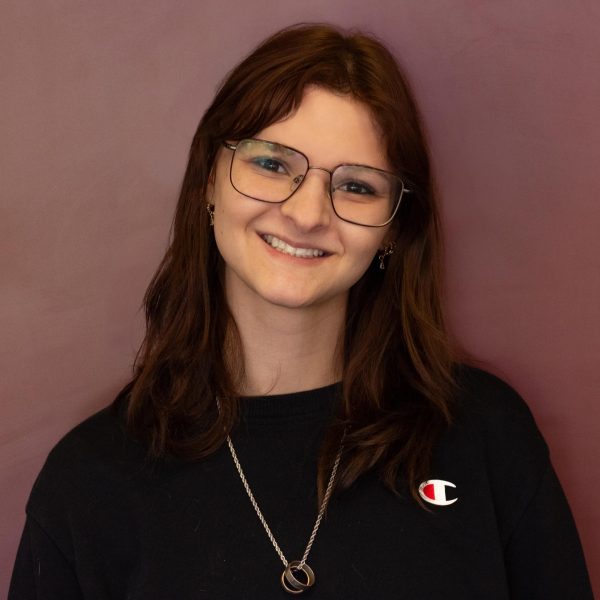
Marina Oquendo, senior art history, global Latinx studies and Spanish triple-major, joined the project as a sophomore. At the time, the Conmemorando project remained self-contained, and researchers had made no definite plans to showcase the research.

“The exhibit wasn’t on my mind in my sophomore year, actually, the show that was in the Neidorff Gallery at the time was a show all about Nivia Gonzales, who’s one of our featured artists. She’s an alumnus of Trinity and went on to be very popular in the ‘80s and ‘90s,” Oquendo said.
After her initial encounter with Gonzales’s work in 2023, Oquendo met Lisa Castro Endresen, who manages the Neidorff Gallery. Oquendo said that Castro connected her with Schnur and Abreu-Torres, and she joined the Conmemorando project as a research assistant.

“That summer, I was interviewing people for oral histories, and I was doing archival research. When I was digitizing photographic slides, I don’t remember who I spoke to about it, but we said, ‘It would be really cool if we could show your work in the gallery,’” Oquendo said. “That summer, we connected with Lisa, and we were like, ‘Okay, we’re gonna show it in the fall of 2025.’”
With the help of Castro and the Conmemorando a la Comunidad team, Oquendo curated “Creando Nuestros Espacios,” a compilation of visual artistic works by Latine Trinity alumni, documented by the archival project.
“Towards the end of the summer of 2024, we started planning,” Oquendo said. “We reached out to the artists to see who was interested. And then eventually, as we got closer to the date, it was like, ‘All right, we need artworks, we need to figure out what’s going to go on the show. We need to get artist statements and bios, we need to figure out programming.’”
Oquendo said that the Conmemorando project revealed how Trinity Latine artists contributed to a broader artistic movement in San Antonio by connecting scattered facts to a larger historical narrative.
“One of our artists, Norman Avila, started the San Antonio Museum of Modern Art, a gallery that was around from 1976 to ‘79,” Oquendo said. “[It] was really interesting to see graduated students who were taking the initiative to show their work in an art environment that actually wasn’t all that friendly to Latino artists.”
As the team traced alumni contributions to San Antonio’s art scene, they found that despite their common education, these artists pursued a wide range of aesthetic styles. Oquendo said their diverse works invite conversation about the meaning of Latine artistry.
“I think that the beauty of it is that these artists went in completely separate ways, in the art that they made and the paths they pursued with their lives. That’s a big question that we talk about: What does it mean to be a Latino artist?” Oquendo said. “It’s a loaded question, but what we’ve narrowed it down to is a commitment to your community and addressing parts of your lived experience through your work. Everybody addresses their own lived experiences differently.”
*This article was updated on Oct. 4 to correct the spelling of Marina Oquendo’s name, which was spelled “Orquendo” and “Orquedo” previously. The Trinitonian apologizes for this mistake and is committed to ensuring that our coverage is factual and reliable.