For Abra Schnur, Trinity archivist and founder of the St. Mary’s Strip History Project, the Zapata mural grabbed her attention first. Her connection to the strip goes back to childhood, eye-level with the painted image of Mexican revolutionary Emiliano Zapata on the side of El Milagrito Cafe.
“Art sticks to children,” Schnur said.
Schnur has been building the St. Mary’s Strip History Project since 2020, which advocates for and promotes awareness for its history from 1980 to 2010. She pulls records from newspaper archives to trace the Strip’s development from a commercial street into an entertainment district, and through the gentrification she said followed the construction of U.S. Highway 281. The project also aims to have the city designate the Strip as a Cultural Heritage District.
Hallie Martin, senior marketing major, works to document San Antonio’s murals. She is researching a single mural — one along St. Mary’s — for a class project in Assistant Professor of Art Marisol Villela Balderrama’s class, ‘Public Art Across the Border.’ Schnur said the work is urgent: Gentrification and building sales continue to erase public art from the Strip with little warning.
The founder of El Milagrito Cafe, Gilberto Sonora Sr, commissioned murals of Zapata over the years to honor the Mexican Revolution. For Schnur, it remains an early example of what the Strip’s public art has long done: hold memory for the people who pass through it.
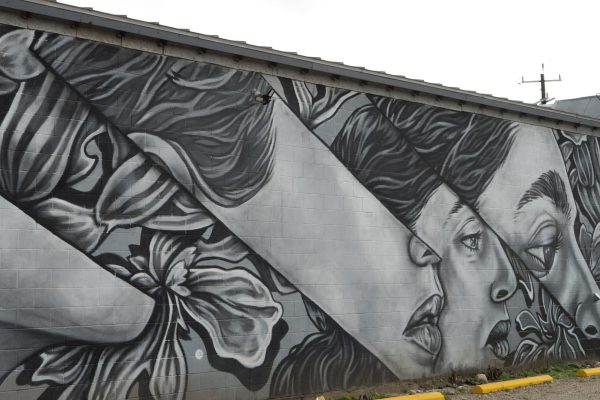
That same idea is now the subject of student research projects in ‘Public Art Across the Border.’ For her final, Martin is studying Mexico City-based artist Paola Delfín’s mural “Fragmentos No. 3.”
“Fragmentos No. 3” is a fully monochromatic mural, rendered in black and white, depicting women in three fragments. Martin said its placement on the street creates a visual effect for drivers, with each fragment coming into view one at a time, creating a sense of movement.
Delfín, who works in communities around the world, creates murals that reflect the people and histories she encounters, Martin said. She interpreted the work as a reflection of feminine identity and representation.
Student researchers should sit with a mural on their own before seeking out the artist’s stated intention, according to Villela Balderrama. “The artwork has a life of its own,” she said.
Murals in San Antonio frequently carry layered references to Latine identity, Texas history and local symbolism that shift depending on who is reading them, Villela Balderrama said. Documentation of the city’s growing public art scene, she added, remains inconsistent.
Villela Balderrama recalled being told about a mural honoring musicians in San Antonio — “La Musica de San Anto” along Commerce Street. “Then, someone bought the building and whitewashed it,” she said.
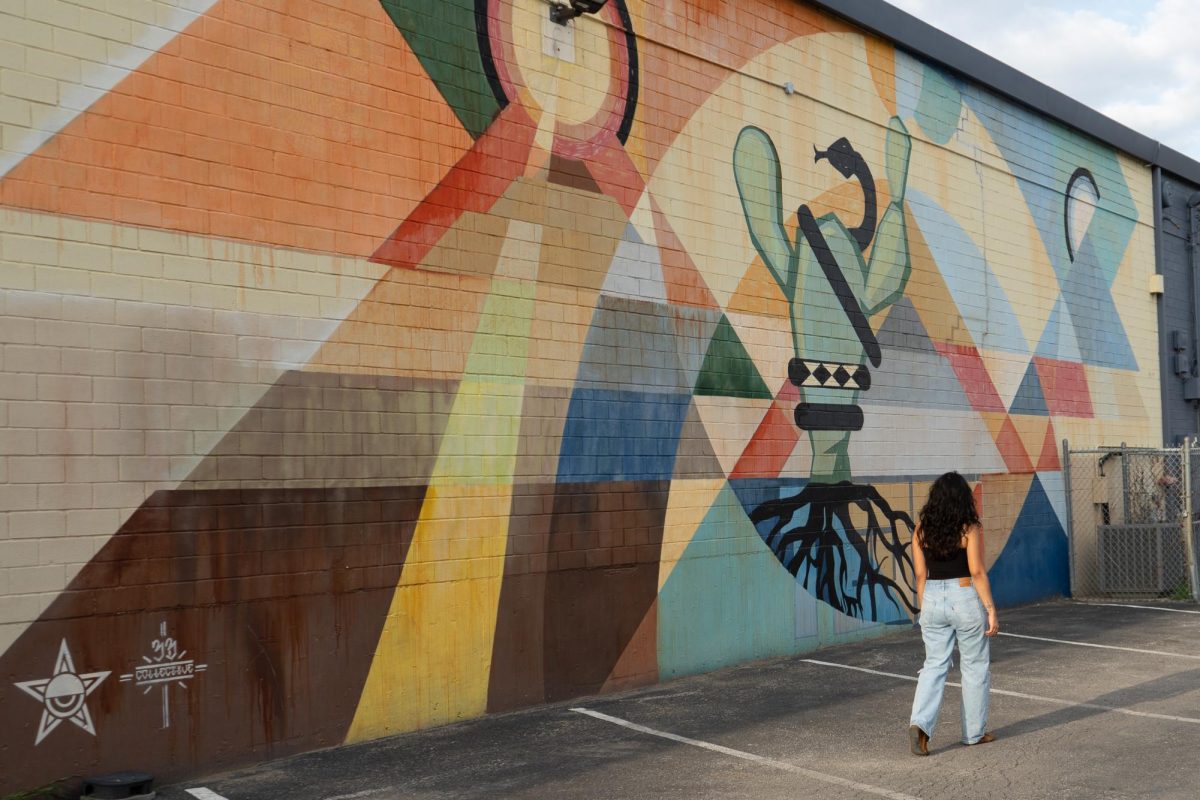
Schnur noted that the Strip has seen a growth in murals over the past 10 to 15 years, suggesting that part of that growth may be due to post-pandemic efforts to draw people back to the area following construction.
Beyond economic factors, Clover Focke, sophomore sociology and religion double-major, said San Antonio’s identity as a minority-majority city shapes how the Strip’s murals function, by giving communities a public place for grief, resistance and hope projected through art and color. Focke works in Special Collections and Archives — separate from the St. Mary’s Strip Project — and pointed to Rafael Gonzales Jr.’s “Un Verano Sin I.C.E.” (A Summer Without ICE) in Beacon Hill, which has become an impromptu memorial site for community members detained by ICE.
“The community is only as strong as the foundation it’s built on,” Focke said. “Murals are community decisions. They emulate community anxieties.”
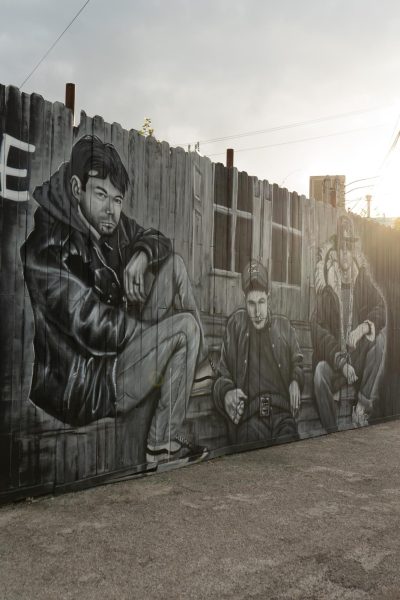
Nearby, Paper Tiger boasts a black-and-white typographic mural titled “Beastie Boys” by Nik Soupè, featuring a Beastie Boys quote about the treatment of women. Unlike the Strip’s more colorful murals, Focke said, this mural sets itself into its surroundings, making its message feel like a natural extension of the space. For Focke, the mural’s message extends beyond its placement.
By the time the Trinitonian captured the Soupè mural, the quote had been spray-painted over — a reminder of what Focke, Villela Balderrama and Schnur all warned: Murals on the Strip can disappear without notice, and often do.
Schnur is planning a history harvest event on June 5, where two summer research interns, Alexandra Oshman and Sophia Gonzalez, will conduct oral histories and trace the Strip’s business changes through city directories. “I call it a project,” Schnur said. “But I don’t think it’ll ever really end.”
*This article was updated April 23 to correct multiple inaccuracies in the story. Schnur does not document the murals on the strip, and Focke works in Special Collections and Archives, not on the mural project. The final paragraph was also published twice. The Trinitonian is committed to publishing factual and accurate reporting, and we apologize for our mistakes in this article.