One-third of the Washington Post’s staff was laid off last Wednesday.
Sit with that for a moment. A nearly 150-year-old newspaper. A family-founded newspaper. The newspaper that broke the Watergate scandal. The newspaper that reported on the loss of Trinity’s very own Aidan Heartfield. That newspaper lost one-third of its staff — an estimated 300 people, including the entire sports section.
It’s horrifying. The opposite of democratic. And completely, utterly unsurprising.
I know you know how bad the state of journalism is. It’s become common knowledge. Almost a running joke. There’s literally a TV comedy, “The Paper,” based on how awful the industry has become. But I don’t think the effects are really clicking with our audience.
I know I’m joining the chorus of voices screaming to tell you how awful this is, but I’m doing so because I don’t know if you really get it. I don’t know if you know how pervasive this issue really is. I don’t think you know that it could affect you. I’m screaming about this yet again because I need you to know how significant of an issue this is.
I’m going to start with my own personal experience — anecdotal evidence, I know — but I think that’s important. It’s why I’m a journalist; anecdotal evidence gives people something that numbers don’t.
I’ve considered myself a journalist for less than two years, but in that time, I’ve worked for two papers aside from the Trinitonian: the San Antonio Current and the Fort Worth Star-Telegram.
I started at the Current, San Antonio’s biggest alternative paper, in December. The first time I showed up, I drove to the wrong location. I drove to their original office: a blue building with a multicolored mural and the word “CURRENT” plastered on one side. I didn’t realize until a kind man told me that they no longer worked out of that building.
Instead, the Current is located in a cute renovated house off of Mistletoe Avenue, with fewer than 10 permanent staff employed under them. They share the building with other companies, and though they have the entire second floor to themselves, I’ve never seen more than four people in there — and one of them worked in advertising.
The Star-Telegram, one of Fort Worth’s largest papers, also no longer has its own office — the original, beautiful building in downtown Fort Worth. Last summer, I worked with them instead at CommonDesk, a shared office space. It looks like a coffee shop; I constantly told my mother that it felt like I was studying for finals with classmates.
They’re a huge paper, owned by McClatchy, one of the biggest names in news media, and in November, I got coffee with one of the reporters I worked with. She told me that many of her coworkers — my coworkers — were laid off that month, and McClatchy even shut down their Washington D.C. bureau.
I’m not saying this to belittle the Current or the Star-Telegram. They both do invaluable work, and they’re fantastic at it — not even for the downsizing they deal with. They’re simply fantastic. I’m saying this to highlight struggles they’re going through.
These cases are not isolated, and that’s what I’m trying to tell you. It’s not just the Washington Post. It’s not just local newspapers in small, rural towns. It’s everywhere. It’s every single paper in the entire world, and I’m not being hyperbolic. Even the Trinitonian suffers from the death of journalism.
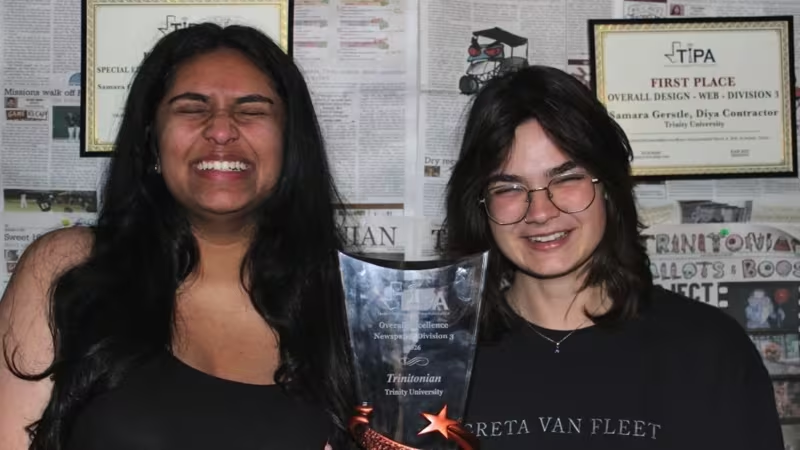
In 2008, the Trinitonian made $2,000 shy of $100,000 in advertising sales. Last year, we made around $14,000, and that’s double what we made the year before. We used to rely almost solely on ad sales; now, we have to convince SGA year after year to make up for that deficit. We have to convince them, every year, that journalism is worth keeping at Trinity.
We have to convince them that the Trinitonian offers something that social media or Trinity’s News Center don’t. We have to convince them that having a staggering 50 people on staff is necessary — a shortage, honestly, if we want to keep the news cycle anywhere near the standards we’ve worked so hard to set. We have to convince them that our website is worth it, that our weekly print papers are worth it. That unbiased, verified information is worth it.
It’s only a matter of time until someone decides that it’s no longer worth it. It’s only a matter of time until the Trinitonian is printed only monthly — or completely online-only. Maybe future leadership will decide it’s not worth the weekly all-nighters. Maybe SGA will decide we’re not worth the money.
That’s the first step. You should see that as an issue, because once that happens, it’s only a matter of time until the staff size dwindles. Until someone decides, for whatever reason, that we no longer need a sports section. Or a pulse section. Or any special section. This isn’t uncharted territory, and it’s going to affect the Trinitonian too.
I truly do want to be more optimistic about this; I consider myself an optimistic person. But with this, I can’t be. I know I have a personal stake in this, and I’ll admit, part of the reason I’m so pessimistic is because I know this is my future. Like Managing Editor Diya Contractor wrote in last week’s editorial, there’s a reason I’m doing this, and that’s why I’m so upset. It gets harder to do our work with every layoff and every missed ad opportunity.
But I’ll be gone before the Trinitonian’s gone. You, though, may not, and once that happens, you’ll no longer have a voice. Our entire goal is to publish unbiased, verified news. Our goal is to bring together voices — to bring together the voiceless. To shed light on issues that are too “taboo” or too “silly” for any other group to talk about.
Without the Trinitonian, there will be no more unbiased, verified news at Trinity. You’ll have to rely on your angry, anonymous classmates on Fizz. Or the tiny event snippets in LeeRoy. Or the university’s incredibly biased (because it’s meant to be biased) News Center on their official website.
I know how angry people get when we get our facts wrong, and they should get angry. We need to be held accountable for our mistakes. But imagine how anger-inducing it will be when there’s no one to hold accountable for that false information. When there’s no accountability at all.
You’ll be shouting into the void to have your voice heard. There will be no centralized outlet for your information. You’ll go uninformed. There will be no one there to hold SGA or our administration accountable. No one there to find the truth behind university rumors or celebrate student success. No one trained to understand what people need to know. No more crosswords. Nothing.
I don’t know what the solution to this is. There seems to be no real solution, and I know that’s disappointing. I’m disappointed, terrified, sad. There are too many causes to count — enough for a whole semester of editorials. There’s the rise of social media, AI, power-hungry billionaires, giant media conglomerates. I could go on.
You just need to know that journalism is important. You need to know how bad the issue really is. You need to know how bad the effects of no journalism are. “Democracy dies in darkness,” and your awareness brings light.
I don’t want to tell you that you individually can change the state of the entire industry, but you have the power to change things at Trinity. You have the power of change through us. You have that power when we’re here.
To SGA, administration, future leadership, our entire audience, fight against the state of the industry. Keep the light on democracy. Keep the Trinitonian here.
*This story was updated on Feb. 23, 2026 to remove misinformation in the 14th paragraph. The final sentence initially included the statement that Trinity University had cut its journalism degree. This is incorrect. Trinity University does not offer degrees in specific disciplines, and the “department of journalism, radio and TV” was renamed the “department of communication” in 1984.