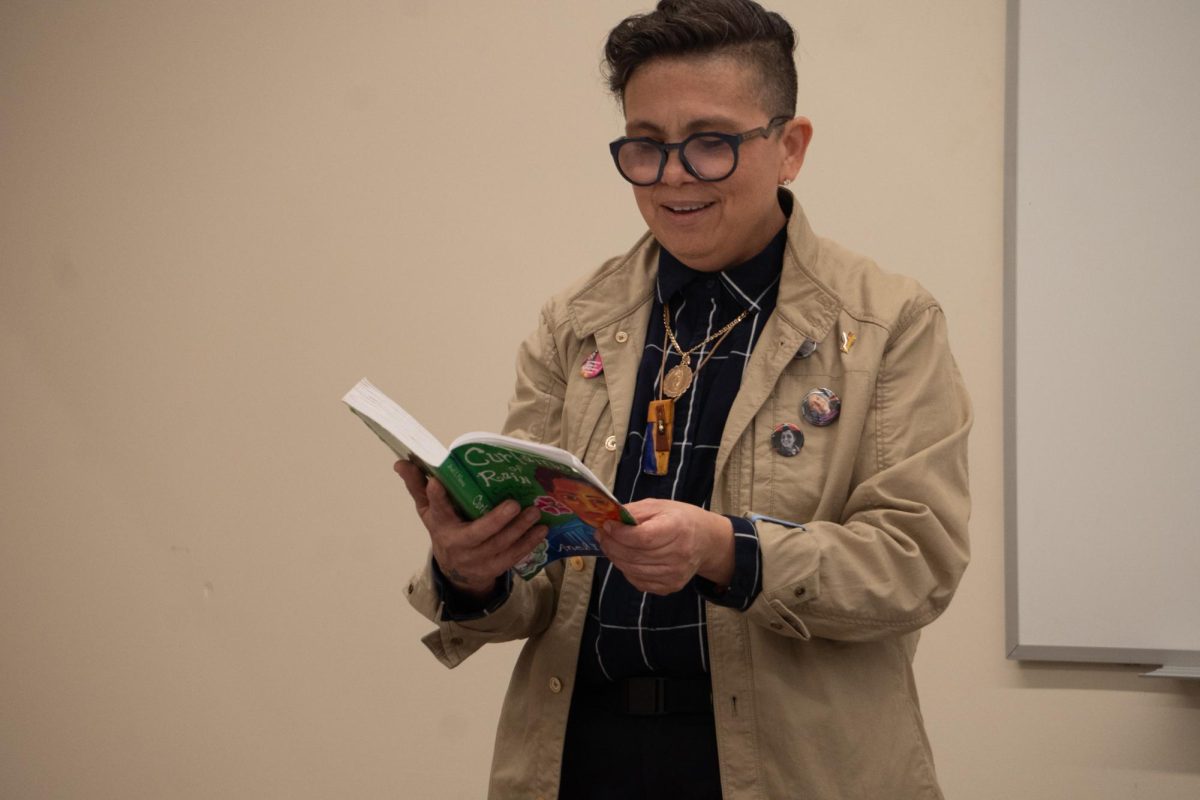
Anel Flores, artist, author and teacher from the Texas borderlands, visited Trinity on Feb. 10 to discuss their newest novel, “Curtains of Rain,” with the “U.S. Latinx Culture and Artistic Expressions” class.
Flores is Xicana/e and queer two-spirit, and devotes their work to studying the male-dominated 1970s Chicano movement through a feminist and queer lens. The Xicana/e movement, she said, focuses on gender equality, while also embracing Chicano heritage. Through their novel, they aimed to center queer representation for young people to see themselves reflected in media, she said.
“My message is to say that there’s queer family out there,” Flores said. “I want my artwork to tell people that they can fly, that they can soar, that they can be everything.”
According to Flores, “Curtains of Rain” is a semi-autobiographical coming-of-age story. It follows the protagonist, Sol, as she navigates growing up queer in a prejudiced community in South Texas — a story similar to Flores’ own background.
“Every character has a little bit of me in it, and every character has a little bit of my mom,” Flores said. “Every character is actually just a combination of every magical queer person that I’ve been blessed to be around.”
Although many Americans view the Texas border as a “crime scene,” Flores said “Curtains of Rain” celebrates love and culture in the region. The novel highlights the beauty of queer and Xicana/e people, while creating a safe space for what Flores calls “queer borderland bodies.”
“It’s a love letter to the borderlands of South Texas,” Flores said. “I have created a world that showcases and highlights the beauty of Latina, Chicana and Mexican culture and how it fuses into queer families.”
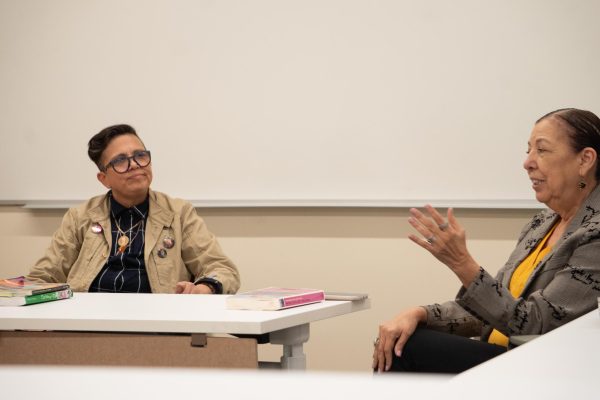
Norma Elia Cantú, Murchison professor of humanities and professor of modern languages and literatures, invited Flores to speak in her class as a local author and artist in the field, but also as a long-time friend. Flores said it was Cantú who wrote an initial outline for “Curtain of Rain.”
The two have been colleagues for over two decades and met at Esperanza Peace & Justice Center. Flores has admired Cantú’s sense of drive and their shared passion for activism in her community, she said.
“Dr. Cantú was someone that I saw when I was probably your age, and I thought, ‘I can do that,’” Flores said. “I want to grow to be that active and that happy and blessed.”