
For a long time, Kate Bush’s 1978 song “Wuthering Heights” was my only introduction to Emily Brontë’s classic novel. Last year, though, I began hearing about an upcoming adaptation of the story, written and directed by Emerald Fennell. I knew Fennell from her previous, salacious films “Saltburn” and “Promising Young Woman,” and her latest work has continued that pattern of controversy. “Wuthering Heights” (2026) is some of Fennell’s best directorial work, but the poor casting and tenuous connection to the source material made the film unsatisfying.
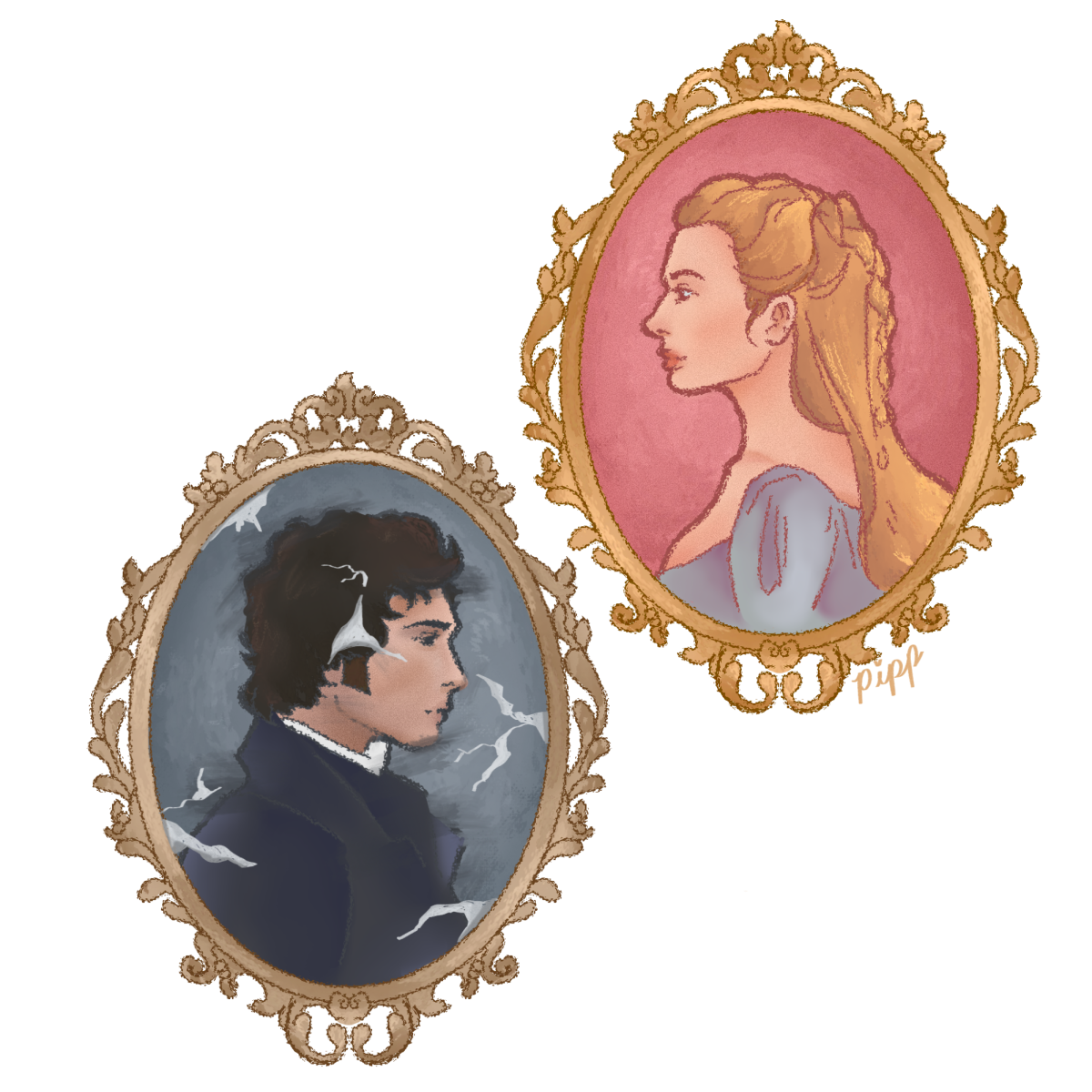
“Wuthering Heights” depicts the complicated, decades-long relationship between Catherine Earnshaw (Margot Robbie) and Heathcliff (Jacob Elordi). After Catherine’s father brings Heathcliff to live with them at their farmhouse, Wuthering Heights, the pair bond and later fall in love. Divided by class, their relationship shatters as Catherine marries a high-born suitor and Heathcliff runs away. Years later, the pair are reunited and struggle to figure out who they are to each other.
As a reluctant fan of Fennell’s work, I appreciate the level of dedication and care she puts into visuals. In “Wuthering Heights,” the vibrant colors tell their own story, illustrating the shifting moods throughout the film. The costuming kept pace with the characters’ dynamic social standings and deepened the characterizations within the story. The set design similarly enhanced this dichotomy and detail.
Beneath the beauty, though, there were aspects of “Wuthering Heights” that were confusing. Specifically, Catherine and Heathcliff’s cruelty doesn’t fully land in the film. Catherine repeatedly calls him a brute, but only in the second half do Heathcliff’s actions somewhat reflect that. The volatility of their relationship is clearly important, but never meaningfully interrogated. The Charli XCX soundtrack was also baffling. Although a good album on its own, every time the rough, electronic songs played, it took me out of the film.
I thought both Robbie and Elordi performed well, yet in both cases, there are inherent problems with their casting. In the novel, the main characters are meant to be teenagers on the cusp of young adulthood.
To Fennell and her casting directors, this must not have been an important detail. Robbie is 35, and the other main characters are similarly aged-up, a mistake considering their juvenile behavior. Without changes to Brontë’s plot, how the characters look and how they behave are clearly disconnected.
Beyond their age, Fennell’s color-blind casting, particularly with Jacob Elordi as Heathcliff, has been subject to heated online debate for months. In Brontë’s version, Heathcliff is a person of color, and one of the novel’s core themes is the different ways race and class affect people’s lives. With this element absent from the film, the impact of Heathcliff’s story is fundamentally changed, and a layer of complexity is stripped from one of the few historical characters of color.
Fennell has made it clear that she was never attempting to make a direct adaptation of “Wuthering Heights.” Like previous adaptations, the film only depicts half of the novel. On the poster, the title is stylized with quotation marks. In an interview with Fandango, Fennell reminded audiences that the film is her version of the story.
There can be good, divergent imaginings of classic novels, like “Clueless” or “10 Things I Hate About You,” but those adaptations aren’t trying to be the original. “Wuthering Heights” is set in the same time period, all the characters have the same names and the plot is very similar. Sure, Fennell’s adaptation includes a wallpaper modelled after Margot Robbie’s skin – veins and all – but that does not make the film a new interpretation. There are elements that Fennell adds to her version, but not enough to make the film distinct from its inspiration. “Wuthering Heights” suffers in all of the comparisons.
“One feral teenage girl’s impression of this masterpiece,” is how Fennell aptly described the tone of her film in a Q&A at the premiere. Since its conception, the film was never going to be a complete adaptation, so don’t be surprised that it falls flat. If you’re looking for a thoughtful film, I’d skip “Wuthering Heights.” To me, all the film is good for is the beautiful B-roll of Jacob Elordi prancing around the British countryside.
*This column was updated Feb. 26, 2026.