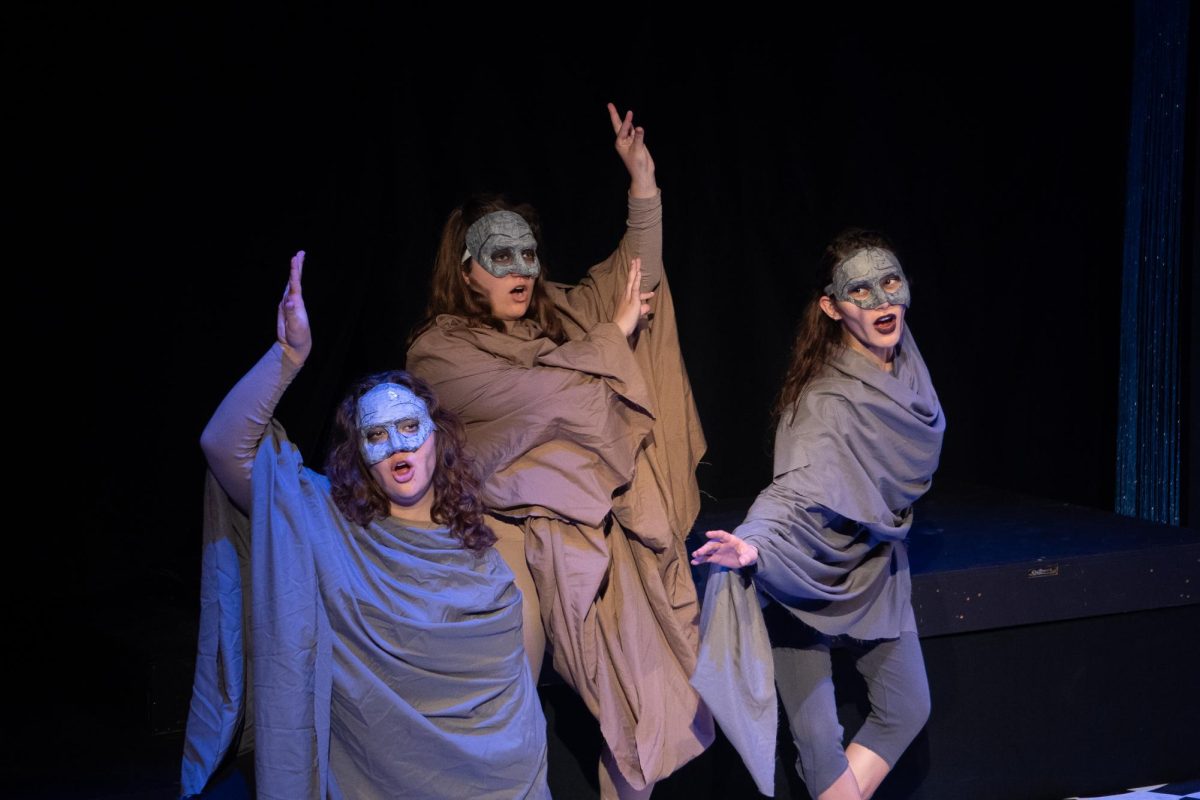
In the Attic Theatre, grief hums softly and lingers. Trinity University's Student Lab production of “Eurydice”, directed by juniors Grace Keller, a theater major with an English minor, and Arwen Loxsom, a theater major with an anthropology minor, retells the ancient myth as part of the Student Lab series.
The production ran March 26-28 in the Attic Theatre as a part of Trinity theatre’s annual Student Lab Series, a program that gives students the opportunity to direct and produce their own work. The play retells the Greek myth of Eurydice from her own perspective, shifting focus toward her experience of memory, loss and transition. The smaller venue places the audience in close proximity to the performers, emphasizing subtle movement and staging.
For Nora Distel, sophomore art history major who plays Eurydice, the role required navigating multiple emotional and physical states across the performance. The character moves between real life and the underworld, forcing shifts in tone, pacing and interactions with other characters.
“There's a live Eurydice, and then there's dead Eurydice, and they're very different,” Distel said. “I view them sort of as different characters, almost.”
Rehearsals focused on building those distinctions through repetition and experimentation. Actors worked through scenes step by step, adjusting their delivery and movement as they built relationships between characters.
“We block, we practice lines, we build connections between characters,” Distel said of rehearsals with directors Arwen Loxsom and Grace Keller. “They're always asking, ‘What do you think?’ which I think is really awesome.”
Rankin, a sophomore communication and English double-major who plays Eurydice’s father, said the collaboration extended beyond scheduled rehearsals. Cast members built relationships outside of rehearsal, shaping how they responded to one another during scenes. These connections influenced timing, tone and emotional delivery on stage.
“Rehearsal, you get to know somebody vaguely,” said Nathaniel Rankin. “Once you get outside of that, you start to really connect with people and you start making better art together.”
As the production developed, actors refined their understanding of character progression, Rankin said. Early rehearsals focused on identifying emotional beats, while later runs emphasized pacing across the full performance. This process helped avoid playing a single emotional tone throughout the show.
“You got to start at the start,” Rankin said. “You take the journey of your character as opposed to just playing them one way the whole show.”
Design elements worked alongside performance to establish the play’s two primary settings: the living world and the underworld. Lighting distinguished between these spaces, reinforcing changes in setting and tone.
Anna Kayser, a sophomore political science major and lighting designer, said the production used lighting to distinguish between settings.
“The underworld is a lot of blues and purples and shifting tones,” Kayser said. “It was a challenge of how to light the actors so everyone can see them, but also give it this sense of darkness.”
Technical effects supported key moments in the production. Light cues were timed to entrances and transitions, requiring coordination between performers and lighting design. These elements were developed during technical rehearsals.
“it creates this really awesome effect with the beaded curtain and the actor,” Kayser said, describing a lighting sequence that uses overhead lights to simulate an elevator descending to the underworld.
These components came together during “tech week,” when staging, lighting and sound were integrated. The process involves running the show repeatedly, making adjustments and refining timing.
Maria Del Río, a senior theatre major and production stage manager for Erydice, said her role focuses on coordinating the production process during rehearsals.
“We make sure everything happens how it needs to,” Del Río said. “We run the show, give notes, make changes and do it again the next day.”
Distel said preparation included managing focus and energy before going on stage. Pre-show routines help channel nerves into performance.
“Nerves… are just your body applauding you,” Distel said. “It’s sort of like, yes — go ahead.”
Although the outcome of the myth is widely known, the production builds tension through pacing and performance. Key moments are structured to sustain audience attention, particularly toward the conclusion.
“Everybody knows it’s going to happen—the moment Orpheus turns around and loses Eurydice,” Distel said. “But every single audience member is going to walk in thinking maybe he’s not going to turn around this time.”
After each performance, cast members transition out of the emotional intensity of the show. The final sequence requires sustained focus, making the end of the performance a shift back to routine.
“The end of the show is so devastating,” Distel said. “I need a second to sort of step out of it and be like, ‘okay, that didn’t happen to you.’”
The production brings together performance design and coordination across student roles. Through rehearsal and technical development in live performance, the student lab series provides a space for students to lead and produce their work.
Eurydice is one of several productions in Trinity Theatre’s Student Lab series, which gives students hands-on experience directing, designing, and performing. The series continues this semester with Is This a Room and The Great God Pan.