What would you do if you were in a position where you could expose a government cover-up to the public? This whistleblower’s quandary is a central theme for “Is This a Room?” — one of the most unique pieces of art I have seen. After a conversation with the show’s director, I was struck by the amazing story behind it: both by the storytelling and Pinkerton’s excellent additions to the production.
Playwright Tina Satter wrote “Is This a Room?” in 2021, and Lyndee Pinkerton, senior philosophy and political science double-major, adapted it. The story centers on a real woman named Reality Winner — a U.S. Air Force veteran and National Security Agency (NSA) translator who was arrested for leaking classified government documents relating to Russian interference with the 2016 U.S. elections.
The script retells the FBI interrogation with Winner verbatim, giving the whole show a unique structure. That premise, Pinkerton’s directorial choice of two actresses as Reality and the deep political themes are what make this one of my favorite plays of all time.
During production, Pinkerton contacted Reality Winner and asked for permission to include additions from her 2025 memoir “I Am Not Your Enemy.” The cast and crew spent hours working with Winner, and their care for her story transforms the original show from a documentary to a biographical work that inspires political thought on a much higher level.
In Winner’s role at the NSA, she became privy to information about Russian interference in the 2016 election. She leaked the evidence to The Intercept, and their mishandling of the information led to her 2017 arrest. She was convicted of espionage and served the longest prison sentence — 63 months — ever imposed for the crime.
Winner must face the internal struggle between her own morals and breaking the laws of a country she has served for years, and it’s extremely compelling. Tension carries through her considerations of how unfair it is to be branded a dangerous criminal, borderline terrorist, while President Donald Trump continues to brazenly leak classified government information with no consequence. You can watch Winner’s psyche break down throughout the show, while her cognitive dissonance strikes deeper at her core identity as an American.
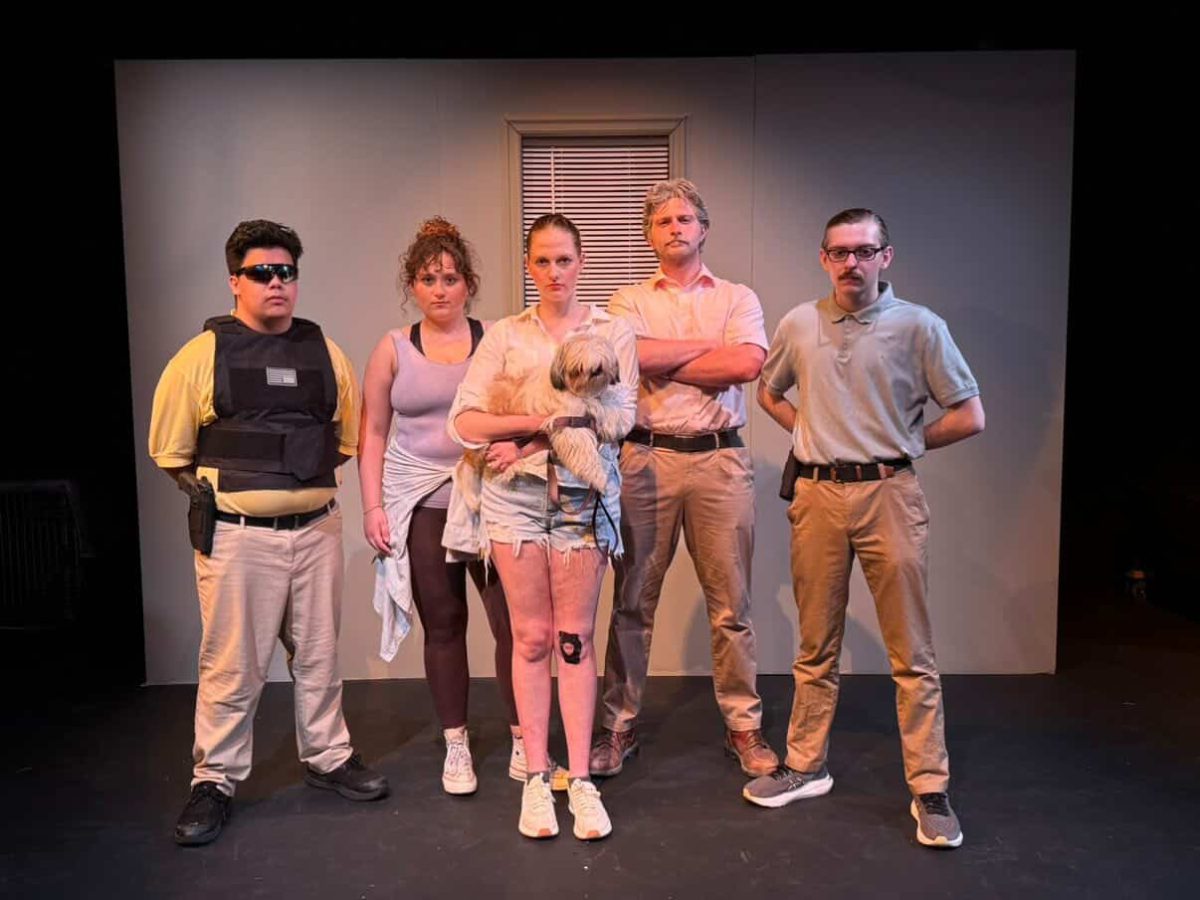
In Pinkerton’s adaptation, there is a past version of the character (referred to as “Reality”) and a present one (“Winner”), that uses dialogue from her memoir.
Winner seems to be watching a playback of the interrogation, reflecting on her younger self’s actions. The interplay between Maggie Goydan (Reality), first-year theatre and business double-major, and Zoe Nolan (Winner), sophomore history and religion double-major, as the character confronts her past self, is what makes the central conflict of the show work so well.
The most common trait found in Winner’s character is uncertainty. We get to see her question her own choices and the fairness of the situation she was put in. Much like the Trump example, she often cannot decide what is “correct” or who’s to blame.
This uncertainty is foundational to the character. It’s self-loathing — wishing she had asked for a lawyer at the time of her arrest — but then she flips this blame, asking why the FBI failed to read her Miranda rights. The layers and questions here, added by having two actresses, was entirely a directorial choice. Seeing it in action, it is an inseparable part of the story, and I’m in awe of the fact that this was made by fellow students.
The amount of dedication put into this production blew me away, and the cast should be extremely proud of what they have put together. You cannot see this version of “Is This a Room?” anywhere else, yet somehow it feels like this is the only way the show should ever be watched.
This is truly something special, and I hope Pinkerton will continue directing in the future. Her background in theater and political science is a perfect example of the power of a Trinity education, and her show is an even better example of the power of artistic expression to fight injustice. To end, I’d like to leave you with a quote from Pinkerton’s director’s note that speaks perfectly to her show’s message. “In the end, if we can empathize with a terrorist, how can we justify the violence being actively committed on our behalf, with our tax dollars, in the name of fighting terrorism?”