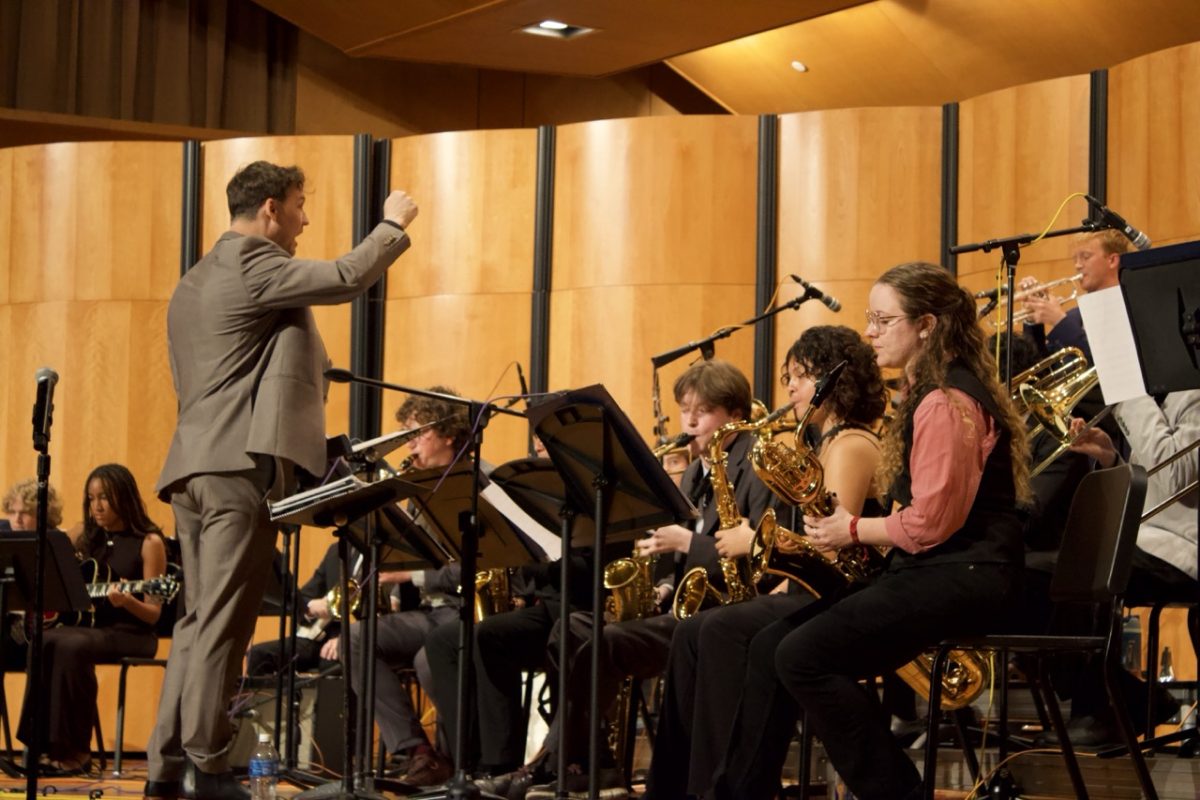
From Duke Ellington to Herbie Hancock, Trinity Jazz Ensemble brought a century of jazz traditions to Ruth Taylor Recital Hall during its annual spring concert on a rainy Sunday.
The Jazz Ensemble took the stage at Ruth Taylor Recital Hall on April 12 at 3 p.m. for their annual spring concert, directed by Ryan Hagler, assistant professor of jazz. Featuring 18 student musicians, the 10-piece set blended works by canonical jazz composers alongside arrangements by local faculty artists.
Hagler, Trinity’s first full-time jazz faculty, said the repertoire was chosen for both educational breadth and deliberate difficulty.
“I think it’s really important to challenge the students and bring some things in that — the first couple of rehearsals — are going to be really, really tough,” Hagler said. “When we pull it off though, there is a feeling of accomplishment.”
That challenge materialized most visibly in Hank Levy’s “Decoupage,” a quintessential odd-meter piece in 5/4 time. Blaise Eakle, sophomore business analytics and technology major, played drums during the performance. The unusual meter demanded patience before it clicked, he said.
“4/4 is symmetrical and dance music, because it comes from marches. It’s natural to us. But 5/4, it’s not as instinctual. After a while it almost feels like 4/4, and you get used to it,” Eakle said. “It was also rewarding. When you play something challenging that you’ve spent a lot of time on, it sounds good.”
For Hagler, difficulty was the point of the curriculum. Hagler said most students in the ensemble are not music majors and don’t listen to jazz outside of rehearsal. That unfamiliarity, he said, is the biggest challenge of preparing a program that spans a century of the genre.
He said his broader teaching philosophy is rooted in finding better ways to get music out of students rather than simply drilling them, which he says stands apart from the high-pressure, competitive environments he trained in himself.
“There’s just no place like that in this environment,” Hagler said. “It gives me the space to really think about what the best practices are in this genre.”
From his experience, Hagler said rigorous music programs can sometimes foster hostile learning experiences. In his classroom, Hagler works against this pattern through passion and care. He said watching students move from frustration to mastery drives him as a teacher.
“Having the students experience that progression — from ‘Wow, we can’t do this at all,’ to ‘Wow, we just did that’ — is a really important piece of the puzzle,” Hagler said.
The ensemble’s repertoire spanned roughly a century of jazz music, from Duke Ellington’s big band era to a recent piece composed by Brian Christensen, adjunct professor of music at Trinity.
Jaylene Benitez, first-year music composition and business double-major, is a tenor saxophonist. She performed two solos during the performance, and said the setlist’s historical depth made preparation feel like more than just learning notes. Rehearsals, she said, open space to reflect on the cultural and historical significance behind each piece.
“Jazz music is like an expression of everything that has been going on, historically speaking,” Benitez said. “If you go back to Duke Ellington’s big band composers, it’s the foundation for what big band music is like today. [Back] then, it was an expression of what was going on.”
Hagler was intentional in selecting pieces that highlight those roots, Benitez said. Songs like Billy Strayhorn’s “Take the ‘A’ Train” reference directions to Strayhorn’s home, while Duke Ellington’s “Harlem Airshaft” captures the sounds of life in Harlem.
The Jazz Ensemble’s next performances take the group off campus: Monks Jazz Club in Austin on April 21 and the 63rd Annual Fiesta Jazz Festival at St. Mary’s University’s Alumni Athletic and Convocation Center on April 24. If you missed their spring showcase, KRTU recorded the concert, which airs on International Jazz Day, April 30.