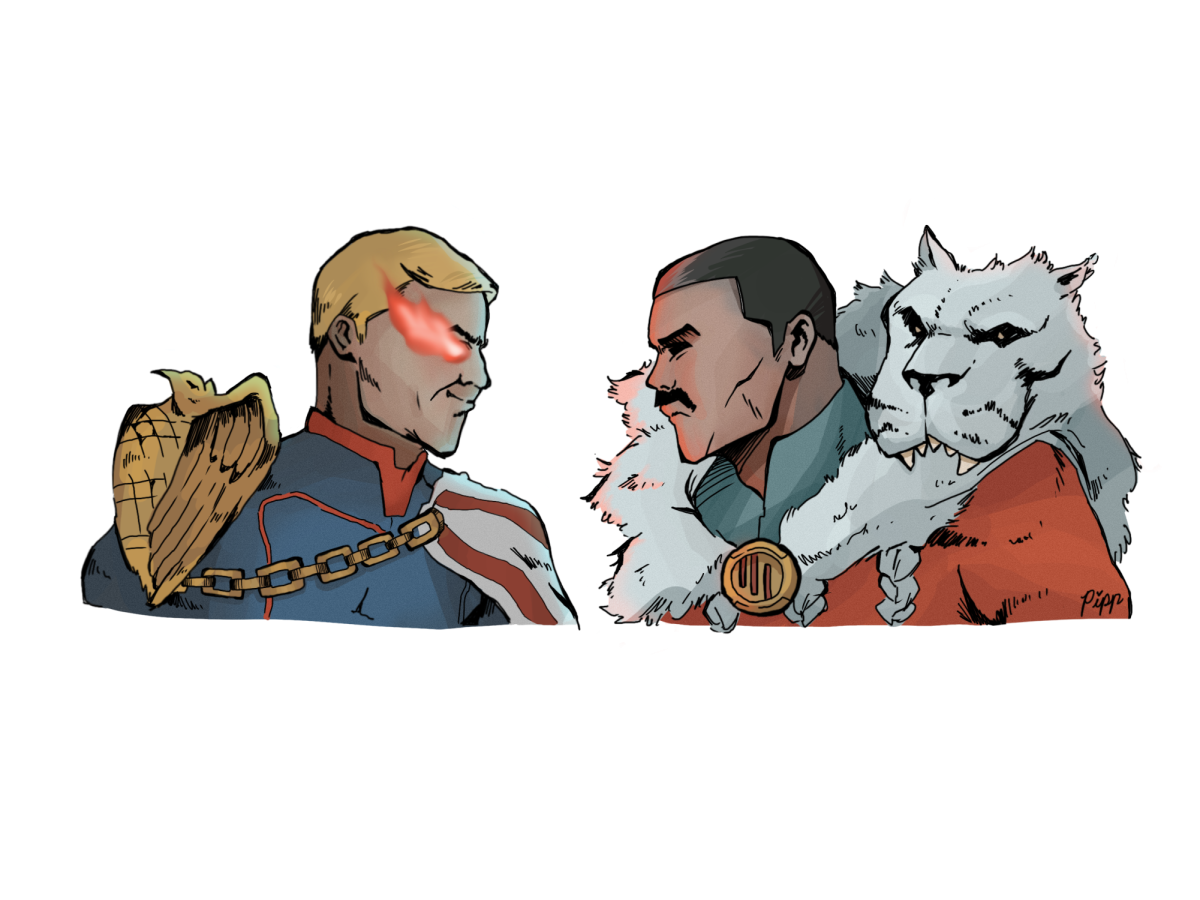

If I had a nickel for every time Amazon Prime released a mature, grounded superhero show based on an “evil Superman” gimmick, I’d have two nickels. That doesn’t seem like much, but it is weird that Amazon green-lit the idea twice. Viewers often compare the two — Robert Kirkman’s “Invincible” and Eric Kripke’s “The Boys.” Both strive to add more realism into the superhero world, especially in showing us what really happens when powerful individuals realize they are untouchable, but the underlying storytelling methods could not be farther off. Both strive for compelling worldbuilding and complex characters, but “Invincible” truly shines in that regard.
Both of these beloved superhero shows are currently airing their newest seasons, so this is a great opportunityfor a superhero showdown. “Invincible” centers on the story of a young Mark Grayson (Steven Yeun) and the struggles of remaining a hero in a world that tries to keep him down. “The Boys” is set in a world where superheroes have been corporatized and hide a dark corrupt underbelly. Both seasons take their respective shows to new narrative highs 78888 “Invincible” in a galactic war and “The Boys” to the edge of a second American revolution after superheroes (“supes”) take over the federal government.
With such high stakes, it becomes crucial to develop the world that the audience genuinely cares about. That’s exactly where these two shows diverge in quality. “The Boys” has some standout character work and attempts to craft compelling B-plots, but fails to tie them in with the larger narrative. “Invincible,” on the other hand, has some of the most mature character writing I’ve seen on TV, and it adds so much weight to the trials the characters navigate throughout the show. The quality of both shows is directly reflected by their individual treatment of these side stories.
“The Boys” season five feels like it wants to take us in a better direction for character-building. In season four, the side plots for our characters, like Frenchie (Tomer Capon) reconciling with his murderous past or Hughie (Jack Quaid) reconnecting with his mother, were wasted potential. The scenes where this characterization developed came and went, proving inconsequential to the larger narrative. Now, it seems they’re trying to correct that.
A-Train (Jesse T. Usher) underwent an amazing character arc, rediscovering his heroism after being part of the corporate machine for so long. This concludes in season five, and it’s a standout bit of storytelling.
Unfortunately, most of the time the show still feels bogged down by its obsession with grossing you out while yelling its messaging at you.
No more obvious is this fact than when watching “Love Sausage,” where a supe uses a rather large “appendage” to fight, beating up prisoners at a Homelander-branded, star-spangled “Freedom Camp.” The complete whiplash between well-done storytelling and explosive, gruesome moments never seems to strike a healthy balance. It takes you out of the moment and makes it difficult for the emotional beats to recover and stakes to feel very compelling.
That’s where “Invincible” comes in. The show also features its fair share of jokes, action and violent imagery, but they take an incredible amount of care to make just as much space for grounded and mature conversations.
Leading up to season 4, Mark’s dad Nolan, or Omni-Man (J.K. Simmons), has been the villain of the story. To redeem himself and reconcile with his son, Nolan must confront the atrocities he’s committed on Earth.
He is contending with thousands of years of galactic-conqueror brainwashing, which is at war with the 20 years he spent learning to be human after being sent on a mission to Earth. His journey to fix his mistakes is so intricate, flawed and compelling, and it’s perfectly accentuated by Debbie (Sandra Oh), his ex-wife and the best written character in the whole show, with her own equally compelling and individual journey. Things like these make it all the more tense when these characters are put at risk.
I love both of these shows, and comparing them has made me realize the importance of the B-plot. “The Boys” has a great overarching narrative, but it struggles to make you care, because it is too focused on its grotesque presentation. “Invincible” trusts us to be patient and revel in humanity amidst super-powered combat, which makes the eventual spectacle much more impactful.
At this point, “The Boys” has smashed away all of its nuance with a sledgehammer, revealing an odd yet compelling sculpture that I hope will come together in its final episodes, airing over the next few weeks. Meanwhile, “Invincible” continues to slowly carve away with a chisel, getting ever closer to completing the masterwork that lies underneath the blood-soaked stone.
*This column was updated April 22