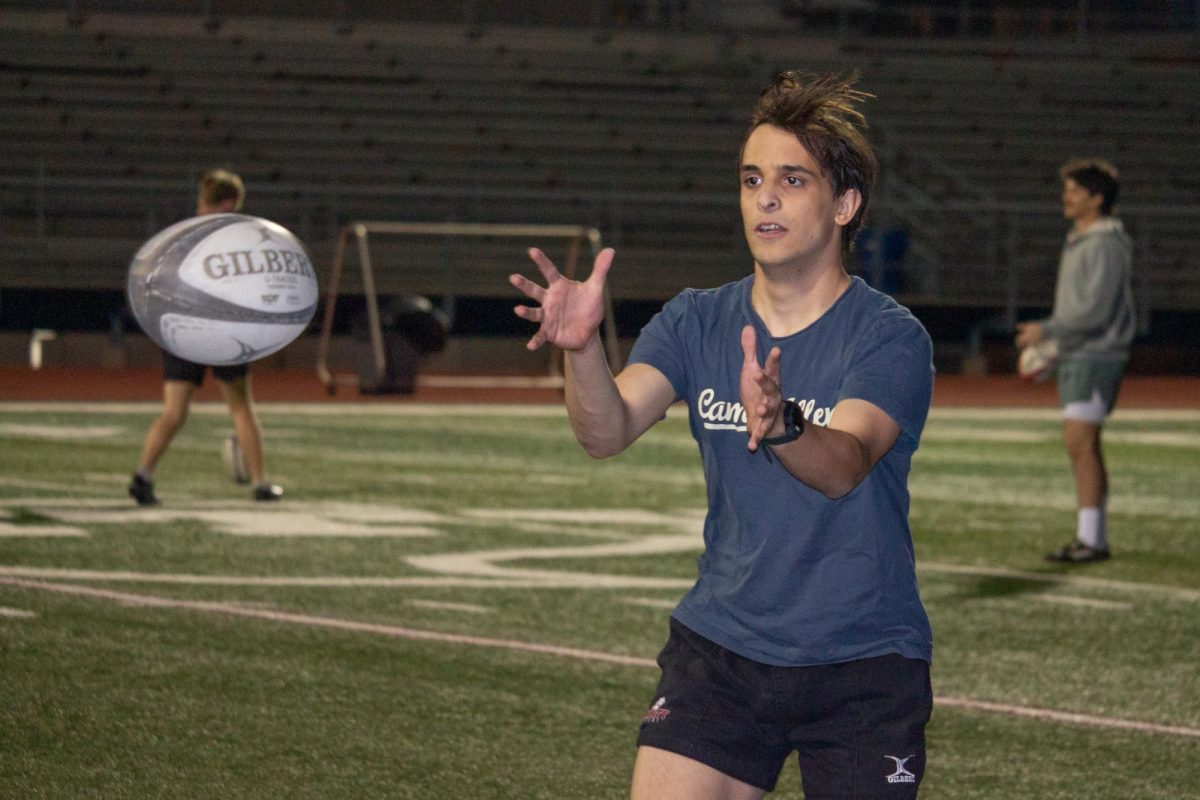
After a run-in with a student wearing an old Trinity club rugby shirt, Zachary Devadoss was inspired to start the rugby club back up last semester. Devadoss, sophomore neuroscience major and team captain, employed the help of the team’s former coach, Arnal Prasad, who shared that the club rugby has been part of Trinity since the 1970s.
Devadoss wasn’t aware the team had ever existed, as he was a first-year when the club fell apar. Before COVID, the team consistently drew strong attendance at practice, won two state championships in rugby sevens and placed fifth in the country. Five years later, the team experienced low numbers, and didn’t have enough players for the 2025 season. Devadoss contacted the former coach, grabbed some friends, dusty equipment from the shed and started up practices.
“The great thing about going into a sport where all of you don’t know a whole lot, is you get to learn together, which is super cool,” Devadoss said. “And then when you go up against other teams, a lot of times there’s not that much pressure for you guys to do super well, especially because we go to such a small school. That’s the expectation of us too. Anytime we’re going into a game, no matter how good our team gets, we’re always going to be an underdog.”
Prasad grew up playing rugby in Fiji. After he moved to San Antonio, he started a club rugby team at his high school with a friend of his. Since then, the program developed into youth and high school rugby teams. He described what has kept him coaching at Trinity, and community leagues.
“It’s the passion of watching players pick up the game that I love so much,” Prasad said. “It’s a passion of mine, and passing it on to another generation is awesome. It’s just watching them find the joy in rugby.”
Rugby’s objective is to score by touching the ball down in the “try zone,” akin to football’s endzones. Teams can also earn points through a conversion kick, which is taken after a team scores a try. Players advance the ball by running with it down the field, but they are not allowed to make forward passes — they can only kick it. On defense, players can tackle opponents to try to get the ball out of the offense’s hands, resulting in a ruck.
For students hesitant to try a physically demanding sport, Devadoss encourages them to just show up and give rugby a chance. He says that while the game can be intense, the team is supportive on and off the field, and newcomers quickly make friends.
“The guys are super great,” Devadoss said. “Everyone is at times brutally honest with you, but they’re always there behind you. They’re always there to support you within the game too.”
It’s the second passion of watching players pick up the game I love so much.[/pullquote]The team typically splits into forwards and backs to practice skills specific to their positions. Devadoss explained that these rugby roles are similar to positions in football. Forwards are the bigger and stronger players that set scrums, rucks and lineouts. Backs are supposed to be quicker and run the ball, pass and score more than forwards.
It’s the second passion of watching players pick up the game I love so much.[/pullquote]So far, the rugby team mostly participates in open tournaments, which means that they play more than college teams. They played their first rugby union game during the fall semester against University of Texas at San Antonio. For college rugby clubs, teams compete in rugby union tournaments in the fall — featuring 15 players on each team, and 80-minute games. Devadoss said they involve more contact. Now in the spring, club rugby will play rugby sevens, which features seven players per team, 14-minute games, focusing on faster pace by passing and one-on-one defense.
Evan Denzer, sophomore engineering major who joined the club this year, said he’s enjoyed learning a new sport and being part of its unique culture.
“I didn’t expect there to be such a big culture even somewhere in Texas, and it’s a very heavy European culture, and I’ve met a lot of really cool people already just playing for a couple of months,” Denzer said.
He encourages others to give it a try, even if they’re new to the sport.
“I had no idea what I was doing, but I ended up making friends and I enjoyed the sport.”
With the team’s resurgence this spring, club rugby continues a tradition starting in the ‘70s. The club schedules practices through their GroupMe and typically meets Monday, Wednesday and Friday at 6 p.m.