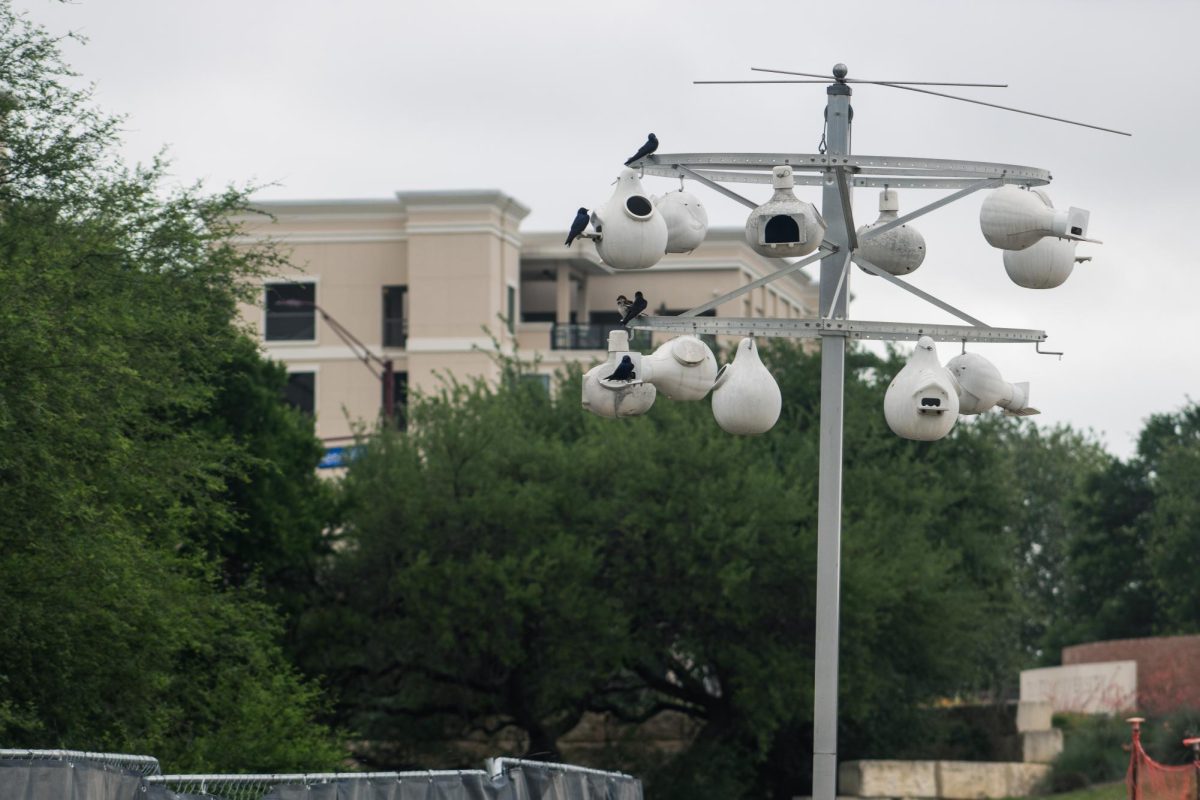
On the route from City Vista to Elizabeth Huth Coates Library on Beneski Parkway, a structure stands out amongst the trees and red brick buildings. A tall white pole is topped by two metal rings, holding 11 large white baubles. The structure is the purple martin birdhouse, installed in 2011 by Mike Scully, a North Side ISD high school science teacher, Troy Murphy, professor of biology, and David Ribble, Dean of the D.R. Semmes School of Science and professor of biology.
Scully installs manmade purple martin homes throughout San Antonio and enlisted the help of Murphy and Ribble to bring a purple martin nest to Trinity’s campus. 15 years later, the Beneski Parkway martin house is still here.
Around the nests, several bird species can be spotted, including sparrows, grackles and herons. However, Murphy explained the nests were installed with one species specifically in mind: the purple martins, a small, dark-colored swallow native to Texas.
Murphy explained that the martins spend the winter months soaking up the sun in South America, then fly back to Texas once the weather warms to mate and raise chicks. While this might not seem too hard a task, the martins are picky when it comes to housing, Murphy said. Like other birds, martins need nesting spots protected from weather, predators and competing birds, but the species stands out in one way: the martins have always lived close to human civilization.
Scully explained that the martins’ instinct to build their nests close to human settlements is unique. While this behavior might seem disadvantageous, it stems from a long history of human-bird relationships.
Scully explained that in the past, Native Americans and purple martins had a close, mutually beneficial relationship. When Native Americans planted a field for crops, they would clear the area by killing surrounding trees. Those dead trees provided the perfect place for martins to live. As humans and martins began to coexist, a relationship started to form.
When purple martins chased crows away from their nests, they inadvertently chased them away from the humans’ fields, protecting their crops. Noticing better crop yields, the Native Americans began to encourage purple martins to nest around their settlements, protecting them from animal predators.
“Those purple martins nesting around people suffered fewer predators, so it became a selective advantage,” Scully said. “Over time, these purple martins would only nest around people.”
Today, however, this relationship has shifted. Though humans’ reliance on martins has lessened, martins continue to live near humans, which comes with risks. Murphy explained that window strikes are an especially severe problem at Trinity, which has many windows that birds mistake for a continuous sky.
“The number of birds that die due to window strikes, just in this country alone, is in the billions every year,” Murphy said. “I hope that Trinity will implement some measures to reduce the number of window strikes.”
Murphy explained that solutions to prevent window strikes include putting dots on glass windows or installing bird-safe windows that do not reflect the sky. As Trinity constructs buildings in areas of campus occupied by birds, Murphy said it will be necessary to implement measures that ensure the avian population at Trinity does not disappear.
Other than window strikes, Scully explained that fewer people know about the martins, and they put up less housing, which has caused the martin population to decline in San Antonio. “The biggest threat [to martins] is people losing interest,” Scully said.
However, there is time to protect the purple martins. By implementing bird-safe windows and installing more housing like the one along Beneski, Scully and Murphy explained, the martins can continue living as members of the Trinity community.
“Purple martins provide a nice reminder that there are a lot of organisms out there that could utilize and share this space with us, if we provide a sustainable habitat for them to use,” Murphy said.
To see the purple martin houses, walk from Coates Library towards City Vista apartments. If you pay attention, you can spot them feeding, gathering nesting supplies and soaring over Trinity’s campus.