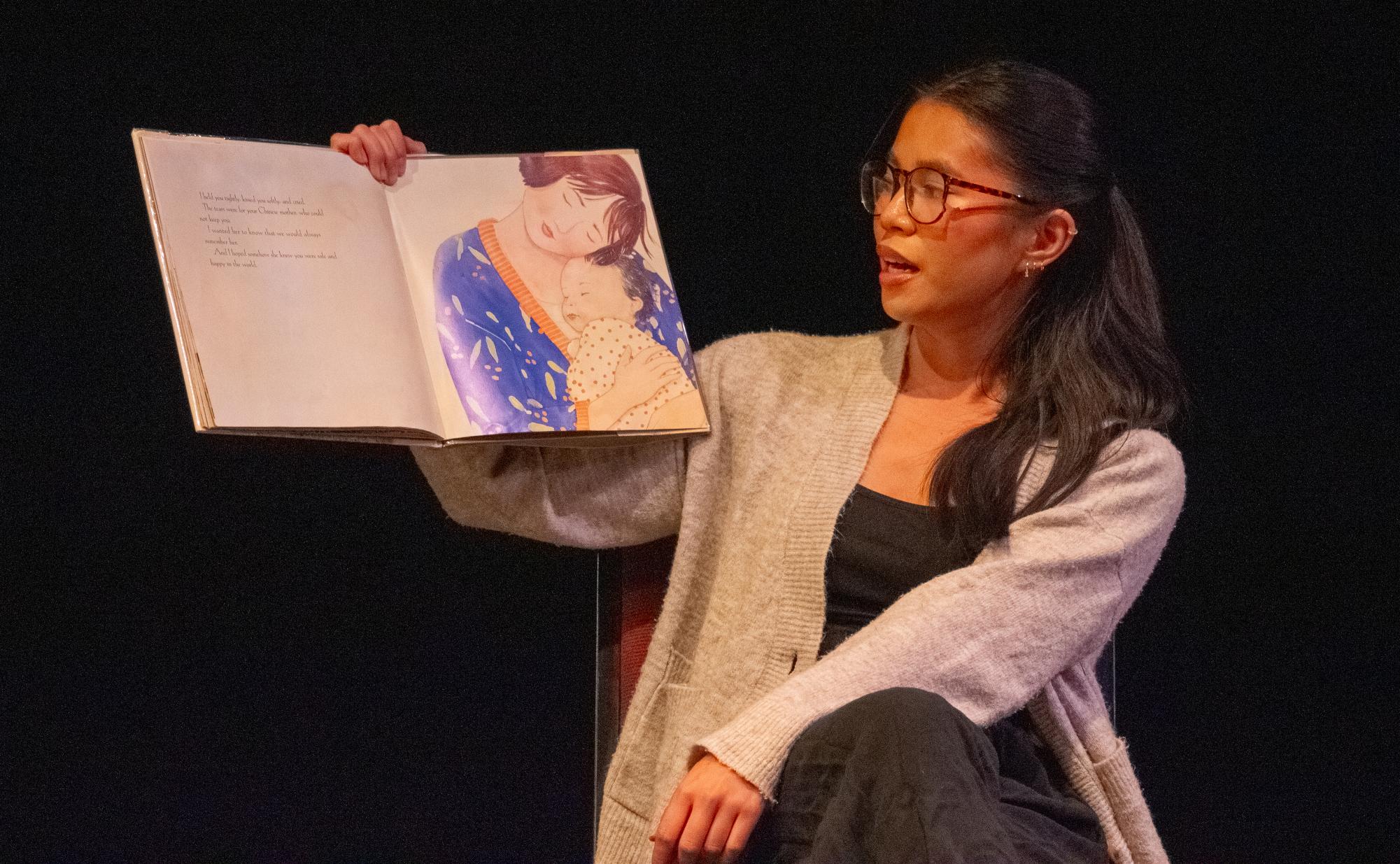
“This is a story about stories,” Leah Ai Ling Woehr, class of ‘20, said to a crowd at the Attic Theatre while standing barefoot on an empty stage. “The ones we’re told, the ones we keep and the ones we leave behind.”
Woehr presented her 40-minute, autoethnographic solo performance, “Grafting, rooting, growing,” during Alumni Weekend on Oct. 25 at the Ruth Taylor Fine Arts Center Attic Theatre. The performance explored themes of transnational adoption and Chinese-American identity.
Woehr is a multi-hyphenate performer, singer and songwriter, and a Ph.D. candidate at the University of North Carolina (UNC) at Chapel Hill. Her research primarily focuses on how Chinese adoptees perform transnational adoption, interculturality, citizenship and familial ties. She previously performed “Grafting, rooting, growing” at the UNC Chapel Hill and at the Teatro Potlatch Festival Laboratorio Interculturale di Pratiche Teatrali festival in Fara Sabina, Italy, but this was the first time she presented it at Trinity.
Grafting — a gardening process in which a branch is joined to another plant so that they grow together — appeared throughout the performance. In a video following her introduction, Woehr’s father recalls learning about vineyards in Italy, where new grape varieties were grafted onto a single rootstock to enrich the wine. For him, Woehr’s adoption similarly enriched his family.
Using props such as a cardigan and a scarf, Woehr played both of her mothers and addressed her complicated relationship with motherhood.
“I’ve had this romanticization of motherhood and of the birth mother,” Woehr said. “I think part of that comes from having strong male figures in my life, while my relationship with my mother was very complicated. There was a lot of love, but also a tension in imagining what mothers should be.”
Arwen Loxsom, junior theater major, expressed how it prompted her to reflect on the complexities of adoption and the experiences of adoptees for a more personal perspective.
“I thought it was really beautiful. Adoption is such a complicated issue, and hearing someone’s individual story made me think a lot,” Loxsom said.
In addition to her idea of motherhood, Woehr talked about her sister Claire, who was also adopted from China. During one segment of the performance, she screened an interview with her sister recording while doing her makeup. Although Woehr said she and her sister have a good relationship, their perspectives on adoption are different.
“Me and my sister do have very different experiences,” Woehr said. “She doesn’t think as critically about adoption as I do because it’s part of my work.”
Towards the end of the presentation, Woehr transitioned to the idea of becoming a mother and how she is not interested in adoption because she does not want her children to experience the angst she went through as an adoptee. She wants to give them a sense of belonging, she said, and grow something new within herself. As she walked to the center of the stage and picked up a chair and guitar, Woehr culminated the presentation by singing a self-penned song.
The performance featured a fragmented structure and mix of theatrical elements, including video, music and physical movement.
Kunsh Tyagi, junior theater major, said the performance resonated with them as a theater student, particularly in how it blurred the line between art and lived experience.
“It was really poignant and personal. As someone who studies theater, it’s fascinating to realize that everything really is a performance — adoption, identity, race — and Leah brought that to the stage with so much complexity and nuance,” Tyagi said.
Another edition of “Grafting, rooting, growing” came to its end, not only with the aim of entertaining, but also of furthering her research. According to Woehr, her academic research is all about Chinese adoption.
“But as a performer, it made sense to ask: How do I translate these ideas into performance? What does performing belonging mean?” Woehr said. “So now the performance itself is part of my dissertation.” It’s both research and creation.”