First-Year Experiences (FYEs) are a group of unique classes for first-years, intended to teach new students how to write college-level essays, take part in discussions and use critical thinking. FYE classes are held Monday through Friday and are worth six credit hours. The FYE workload can daunt students, professors and peer tutors, but the courses provide valuable lessons for all parties, including how to succeed in collegiate academia.
A variety of professors from Trinity teach the FYE curriculum through a writing workshop, an analytical discussion seminar and a lecture for common learning experiences. On the official FYE webpage, the university states that the courses offer an introduction to university-level communication, reading analysis and writing.
Jennifer Bartlett, lecturer of FYE and founded the “Childhood” FYE with Ronni Gura Sadovsky, assistant professor of philosophy. Bartlett is the writing workshop instructor of the “Childhood” FYE in addition to three others this fall: “A Successful Life”, “Science Fiction”, and “Myth and Literature in the Greek and Roman World”.
“I’m always really much more concerned about process and progress than I am about the actual artifacts they [students] are creating,” Bartlett said.
Bartlett uses her FYE courses to engage students in higher-level writing practices to amplify student voices. To do this, she said she wishes to put a heavier emphasis on lowering stakes of an introductory college course through productive exercise assignments that build student confidence as they prepare for upper-division courses.
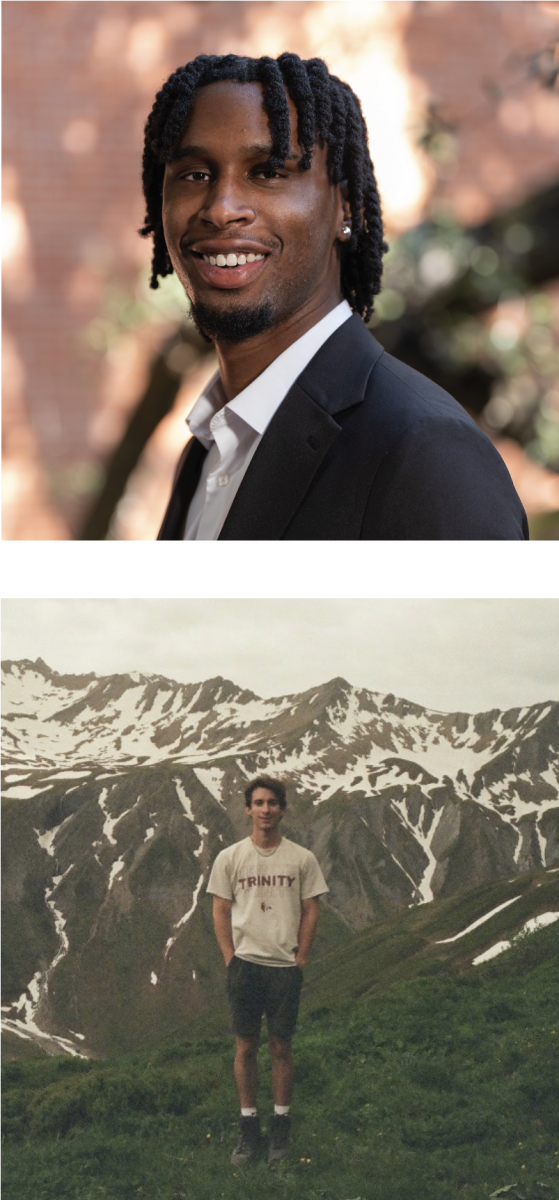
Timandra Rowan, senior biology major, served as a peer tutor for the “Childhood” FYE in fall 2024 and took the “Climate Changed” FYE in her first year. She said that her FYE prepared her for Trinity’s academic discipline, and she continues to hold a solid working relationship with her professors.
“My FYE definitely taught me to write,” Rowan said. “I don’t think that I was a particularly good writer leaving FYE, but it toughened my skin to receive feedback like that from other professors.”
Jack Jones, sophomore environmental studies major, is a peer tutor for and previous student in the “Social Justice” FYE for Habiba Noor, lecturer of education. His biggest obstacle during the FYE was learning how to properly read and comprehend academic papers.
“It is known as being one of the most demanding — reading-wise and paperwise … I spent so much time researching and getting used to online databases, getting used to how to read text, and then applying my own analysis and kind of reach the ‘so what?’” Jones said.
Jones said that FYE has improved his time management skills and provided a center for upper-division content and arguments, which can have lasting beneficial effects for students.
David Spener, professor of sociology and anthropology, is the discussion leader for the “Social Justice” FYE, alongside Alfred Montoya, professor of anthropology, who is the writing workshop leader. Jones said that these professors provided helpful feedback, useful discussions and readings.
However, Rowan said that the university could improve FYEs by utilizing a systematized course structure with a set number of assignments. She said the university should integrate the sciences and humanities, with writing and analysis capabilities valued over content.
“The way I think of FYE, personally, is that it’s a class that’s supposed to teach you how to be a college student,” Rowan said.
According to Bartlett, growing analysis and communication skills in FYEs should be valued over the course’s content. She said that she wished more FYE professors placed more emphasis on the process of learning over the end result.
“This may be a dirty little secret: that the content doesn’t matter as much as your ability to connect with students,” Bartlett said.
James Shinkle, professor of biology and discussion seminar leader for the “Science Fiction” FYE, was recruited by the department to teach his current FYE. He is also on the committee of assessing the efficiency of FYE courses, which will meet at the end of this semester after a four-year hiatus to evaluate students’ progress.
Through the FYE course structure, Jones said he enhanced his time management skills and got comfortable within the world of writing, despite how difficult the curriculum can be.
“It would be such an understatement to say that it was just a class. It really foundationalized my ability to learn and cultivated such a community,” Jones said.
Jones said that while he did not initially know what the course would focus on, he was able to have many conversations with a variety of people while using information from his FYE. While discussing with other young adults about readings or personal anecdotes, Jones said he feels like the FYEs raise important questions about the world.