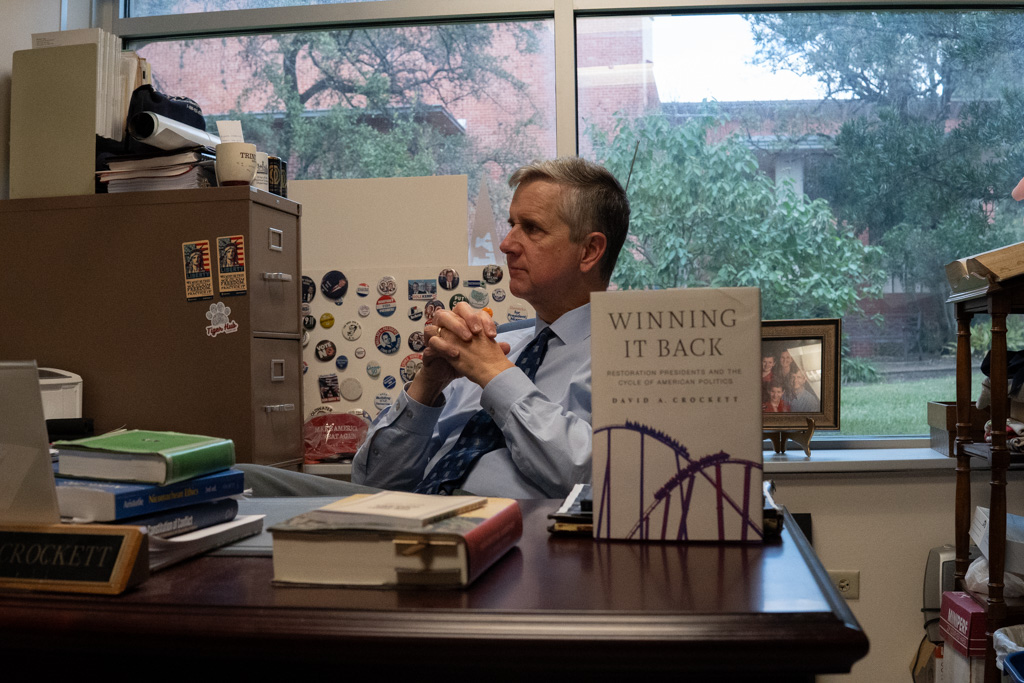
David Crockett, professor of political science, released his newest book “Winning it Back: Restoration Presidents and the Cycle of American Politics” on Jan. 15, 2026. Crockett explained how his book breaks down the rise and fall of political parties through American presidencies and reflected on how teaching has influenced his publications.
“Winning it Back” serves as the conclusion to a trilogy of Crockett’s previous books, “Running Against the Grain” and “The Opposition Presidency.” In this third book, spanning from Andrew Jackson to Donald Trump, Crockett aimed to shed light on the effects of past U.S. presidents’ regime cycles.
“There was always this kind of dangling piece of an undeveloped question, which is: What is the legacy that these presidents leave to their governing party successors?” Crockett said.
To answer this question, Crockett characterized presidents into two roles: opposition and restoration. Opposition presidents belong to the political party not representing the time’s dominant governing ideology. “Restoration” presidents, on the other hand, are the individuals of the dominant party who faced the task of “restoring” their governing agenda after opposition presidents. Beyond transforming his research into print, Crockett spreads this political knowledge to his students.
James Oberwortmann, senior political science and marketing double-major, has taken several of Crockett’s classes, including “The American Presidency” and “Elections and Campaigns.” Oberwortmann said that Crockett does a good job of presenting material in a balanced way that shows the merits of both sides without pushing a particular bias.
“I think he provides a perspective that doesn’t really get shown as often on campus,” Oberwortmann said. “He’s always said that there’s no such thing as a value-neutral political science class because there’s always going to be some opinion, some bias, peaking through, and the more important thing is to recognize and account for your own biases.”
Throughout his experience as an author and researcher, Crockett found that scholarship and teaching have a synergistic relationship. According to Crockett, Trinity’s encouraging environment has helped him develop as a scholar, and his interest in being an educator remains unwavering after all these years.
“I think what Trinity has done is reinforce that this is the right field for me, and that has been very satisfactory and fulfilling,” Crockett said.
In his most recent book, Crockett urges readers to give up high expectations and find acceptance in loss within the election processes’ repetitive nature. Without a healthy understanding of how the political process works, Crockett said, loyal party members become prone to frustration, dissatisfaction and unfairness when their preferred candidate loses.
“When you are part of the dominant party … the problem you have as members of that political party is that you always want to have the next president like the first one,” Crockett said. “If people moderated their expectations with a rational understanding of the actual ebbs and flows of political power, maybe we wouldn’t have the level of polarization that we have today.”
*This article was updated on January 29, 2026