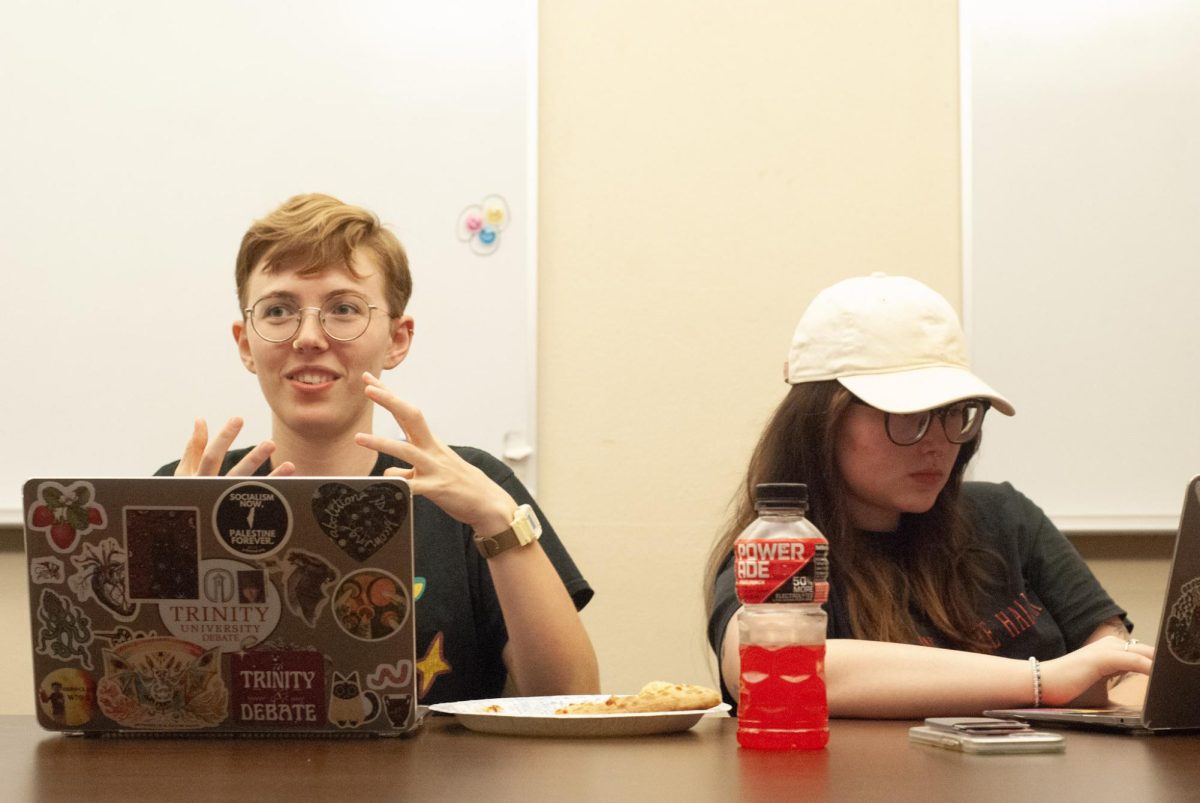
In many ways, the Student Managed Fund (SMF) is a typical Trinity business course. Students meet on Tuesdays and Thursdays, learn about investing, and present financial research to their peers. But grades aren’t the only thing at risk in SMF — $18 million of Trinity’s endowment is at stake.
The class first began in 1998 when Trinity’s Board of Trustees approved an allocation of $500,000 of the University’s endowment to be managed by students. Now, Dante Suarez, associate professor of finance and business analytics, leads about 30 students in the current SMF class. Over the past 28 years, students have grown the original donation to over $18 million, gaining invaluable experience in finance along the way, Suarez said.
SMF is a unique program that prepares students to enter the financial job market with real-world experience, Suarez said. The class, most commonly taken by students during their senior year, lasts 2 semesters. By the time they graduate, it’s as if they had already worked for a year.
In the class, students build a portfolio of investments, buying stocks and bonds with SMF money. To make a profit, the class aims to “beat the market” – the benchmark S&P 500, the top 500 companies on the U.S. stock exchange. Beating the market is difficult, but Suarez said the students have made it look easy.
“It’s really hard for even the most proficient professionals to beat this benchmark,” Suarez said. “In the last few years, we’ve been able to do so. A couple of years ago, we not only beat the market, but we beat it by a lot. The phrase that we were using is that we were ‘creaming’ the markets.”
While the primary purpose of the SMF is educational, it also makes money for Trinity. Accounting for inflation, the SMF has generated around 2 million for the university, just from positive return on investments, Suarez said. Last year, and for the first time in the SMF’s history, Trinity took $500,000 from the fund to spend on general university needs.
While other universities have student-managed funds, Trinity dominates in the size of the fund and the direct decision-making power of the undergraduate students, Suarez said. At many universities, Suarez said SMFs are only available to graduate students, or students are limited to making recommendations for the budget. At Trinity, though, students work hands-on, directly deciding how to manage the fund.
“ Here, in the student-managed fund, I have a vote, and every single student there has a vote,” Suarez said. “So the fund is really, truly managed by the students.”
In mid-February, Suarez selected five top students in the current SMF class to participate in the Chartered Financial Analyst (CFA) Regional competition. Collin Bishop, a senior finance and economics double-major, participated. He said his experience in the class prepared him for the hard questions.
“When we present [questions] like this in our own classes at Trinity, our own classmates ask 10-times harder questions,” Bishop said.
At the competition, all teams receive the same stock and must research and present their findings to a group of judges. Trinity’s CFA team won first place at the regional competition and will move on to the state competition in the coming weeks.
Michael Hinchliffe, class of ‘25, is a former member of the SMF class and now an investment professional at J.P. Morgan Wealth Management. Hinchliffe expressed that his direct experience working with large sums of money in the SMF class set him apart in the job market and gave him invaluable knowledge in finance.
J.P. Morgan chose Hinchliff out of a pool of 150 applicants, many with over 20 years of experience, he said. Once hired, J.P. Morgan professionals told Hinchliffe “point blank” that his work in the SMF fund was the type of experience they were looking for. He joked about giving some of the money he makes back to Trinity.
“Things like the SMF put me in a better position to be successful, and hopefully one day, I have a billion dollars, and I can put my name on a building or something,” Hinchliffe said.
Some people may judge or misunderstand the program for its connection to a vast amount of money, Suarez said, but the students don’t have access to the SMF fund for personal use. Financial literacy is imperative in the current global culture, Suarez said, and he teaches that in the SMF.
“I grew up hating money, especially hating opulence. But at the end of the day, I feel like we do live in a capitalist economy, and this has to be run, one way or another,” Suarez said. “Even if you want to save the turtles, you’re probably still gonna need money to do that, right?”
SMF members will compete at the regional semifinals CFA competition in New York in April. At present, they are continuing to make investments, aiming to “cream” the market once again.
*This article was updated on March 7, 2026