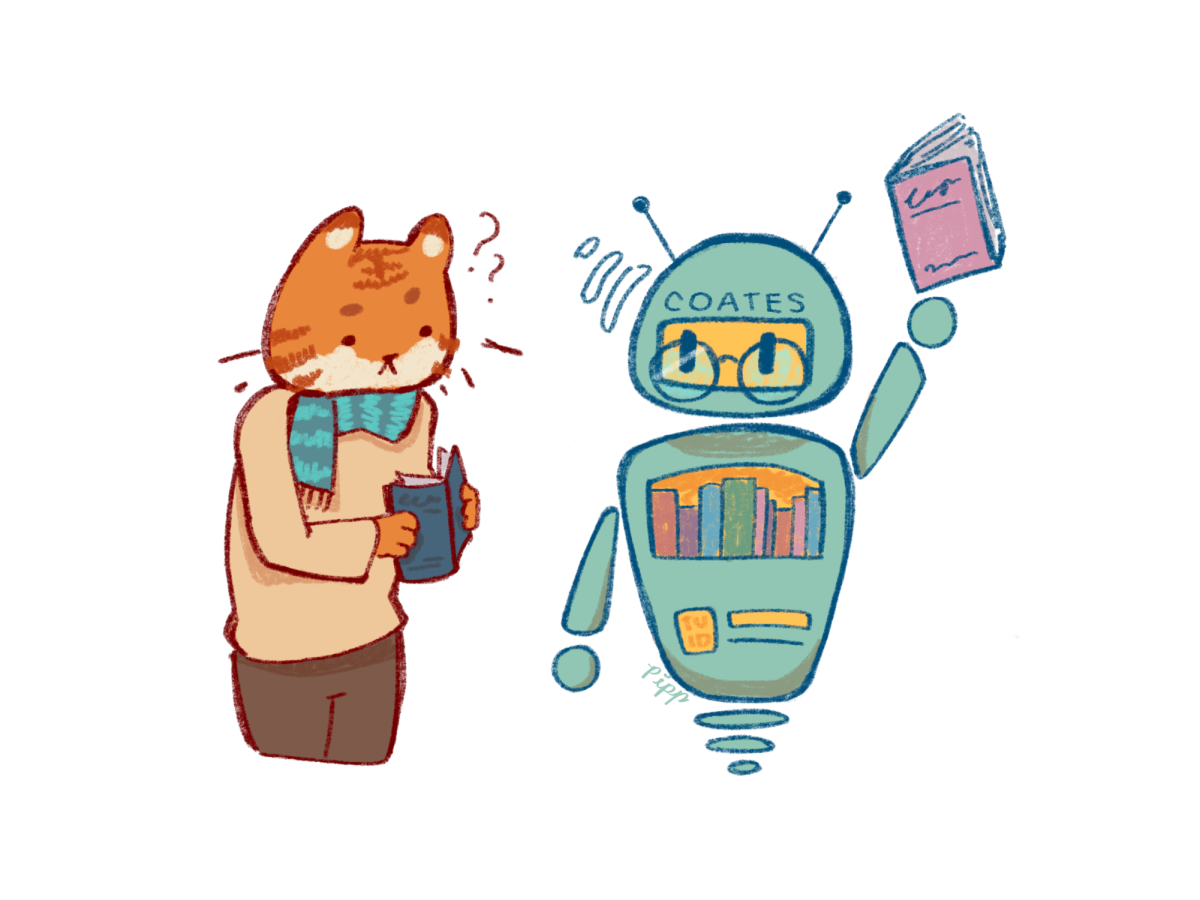
As over 90% of college students now use AI, according to Forbes Magazine, Trinity students are beginning to learn how AI may be incorporated into their own classrooms. Though some students expressed concern about the way it would affect their education, they also shared that it can be helpful as academic support.
Cyrus Terry, first-year geoscience major, thinks of AI as a support system. “If I get stuck on something, it can do a great job explaining the material from a different perspective,” Terry said.
He said it changed the way he studies, and Grover Bendell, first-year biochemistry and molecular biology major, said the same. It can be a beneficial tool for studying in a variety of ways, he said.
However, despite noting the ways it could benefit students, Bendell shared that the temptation to abuse it is still there. AI offers easy access to information and can personalize support, but for Bendell, that can make academic effort optional. As a result, he said he limits his usage, extending it only to AI Gemini results.
“It can understand my questions easily, but now that I’m more familiar with it, I’m more cautious about using it, which allows me to form a more well-rounded understanding of the course content,” Bendell said.
Other students, though, lean into that temptation, and Terry said that it’s present for many students. “I feel like AI requires a lot of self-control to use, and it’s really easy to fall into the habit of directly asking it for the answer,” Terry said.
Beyond the student landscape, Kevin Hearn, Academic Technology Manager for Information Technology Services, said that faculty have concerns about students using AI in ways they shouldn’t be. “It’s not that they never want students to use AI, they just have concerns about students using it in ways that aren’t consistent with how they should be learning the content,” Hearn said.
“When I was in college, I couldn’t use a calculator for calculus I and II,” Hearn said. “I wasn’t able to use it because they wanted me to learn how to do it in my head on paper, without shortcuts. I think that’s where faculty are at right now.”
Regardless of whether a student uses AI or how they use it, when taking a test or quiz, they will have to answer questions without that additional support. “I think that it’s important for us to develop critical thinking skills without AI because we don’t always get to use it and shouldn’t become reliant on it to do our thinking for us,” Bendell said.