*This piece is entirely satirical. Read the rest of our April Fool’s edition, the Trinibonian, here.
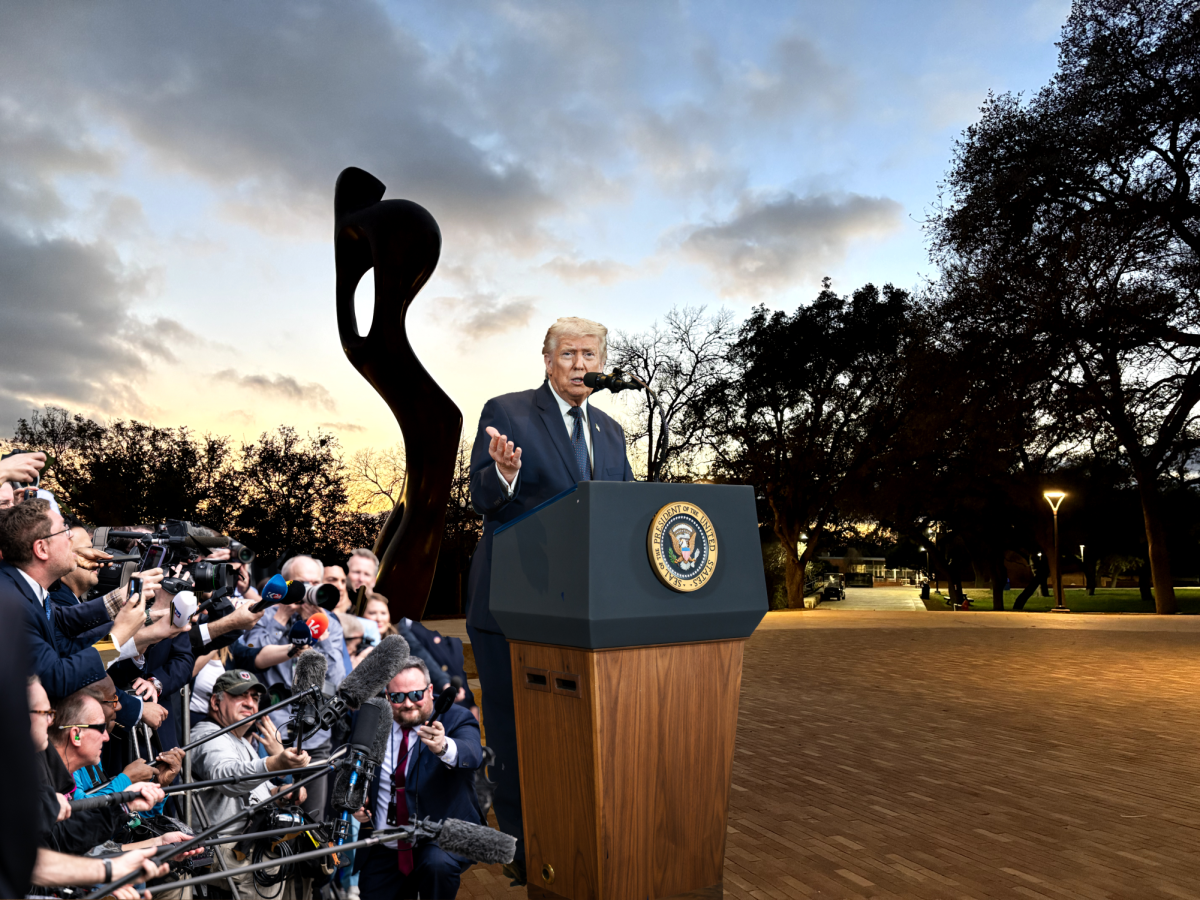
In a decisive and deeply unsurprising move, federal regulators have officially shut down the Trinibonian following a highly confidential investigation by multiple governmental agencies, including the Occupational Safety and Health Administration, the Department of Health and Human Services, Department of Labor, and many more. The threat level has reached DEFCON 5, levied through “weaponized information, however accurate.” The Attorney General, Spam Blondi, has yet to comment on whether federal charges will be filed against its editorial leadership.
The investigation began shortly after Trinity launched its online hazing prevention training, in compliance with the federal Stop Campus Hazing Act, which the Trinibonian reportedly treated as “less of a warning and more of a blueprint.”
A joint federal report concluded that the paper’s workplace culture constituted a “preventable and debilitating threat” to student well-being, noting prolonged exposure to “editorial-decision making” as a primary risk factor.
Editor-in-Chief Ham Gristle and Managing Editor Diva Constructor were reportedly “inspired” by one of the training’s hazing examples.
“It was lowkey a good idea,” Gristle said. “Bad execution, though. Oops.”
The scenario described a fictional newsroom policy requiring staffers to carry press credentials at all times, with repeat violations resulting in 48-hour sleep deprivation and compulsory service to editors’ “every whim and fancy,” according to Gristle.
The Trinibonian’s leadership adopted the policy with minor adjustments, reducing the allowable number of violations from five to one, to “maintain standards,” Gristle said.
The first staffer to be caught without their press credentials was Waddy Worrow, Ballers reporter. She described the situation as “technically survivable, but spiritually harrowing.”
“All they had me do was buy them coffee, stay awake at night while they did their page layout, and stalk a source who wasn’t responding,” Worrow said. “Watching the editors crash out over Adobe InDesign was insane, though. I felt scared for my life, like I was witnessing something federally illegal.”
While other staffers reported relatively mild experiences, conditions escalated in subsequent weeks, prompting anonymous distress calls to the federal whistlesucker line. Callers alleged that the Trinibonian executive leadership had “gone certifiably insane,” and had become “increasingly unwell in a way that felt sinisterly organized.”
A snitching staffer, who spoke on the condition of anonymity and self-preservation, said that they were asked to cover for their section editor while she was sick. Despite being paid, the staffer said they felt pain akin to being burned alive.
“I remember it like it was two months ago, because it was,” the little snitch said. “At 1 a.m, the managing editor, who had yet to see my article, said out loud, ‘We can’t publish this bullshit.’ I had to redo the entire page. I had to rewrite my article while she glared at me, and honestly, it felt demonic.”
Constructor later clarified that she said, “We can’t publish this. It’s bullshit,” referring to the article’s “profound inaccuracy,” and noted that while she was unaware the staffer could hear her, she “stood by the sentiment.”
The article leveled an accusation against a Residential Life assistant for stealing a Trinidog without any corroborating evidence, besides a vibe.
“The [snitch] was assigned an article on the missing dog. They were asked to speak to the Dog Organizing Guild (DOG) alliance and ask whether the dog had been adopted,” Constructor said. “Instead, they talked to a psychic who said the dog had been kidnapped.”
The federal whistlesucker line also received a call from a registered student organization (RSO) on campus about biased coverage and FOMO. The organization declined to identify itself despite repeated and increasingly desperate requests.
“I mean, they just cover whatever they want,” an anonymous member of the RSO said. “Our events are so important to our community. They’re a news organization. We shouldn’t have to personally beg them to come.”
Gristle disputed this claim, saying that the event was neither well-attended nor mentioned by the club’s social media. It took place on a random Tuesday night below a residence hall, and no one but the club’s officers even attended, she said. She called it “fundamentally indistinguishable from a private conversation.”
“How am I supposed to send reporters to an event no one even knew about? I have people monitoring the campus bulletin board, and even the room reservation software,” Gristle said. “And now I’m being called a lefty lunatic by some people and a radical conservative by others.”
Indeed, the paper has also faced criticism from multiple ideological fronts.
Following Constructor’s semi-recent editorial, “Conservatives, come hither,” one student on the anonymous social media app Jizz accused the paper of being “radically fascist,” while others described it as a red herring to disguise their “communist lunacy.” This prompted federal investigators to classify the publication’s political stance as “situational.”
“I mean, whatever? Haters fr fr,” Constructor wrote in an email statement.
An operative at the federal whistlesucker line, appointed specially by the Trump administration, reportedly concluded that the paper had acted “justly,” and encouraged further efforts toward what they described as “conservative DEI, the only acceptable DEI.”
At the time of publication, federal authorities confirmed that the situation has been contained, though traces of free speech are still believed to be active on campus. Trinity officials announced that students affected by the hazing will be offered honorary degrees, counseling, extensions, and in severe cases, free tuition on account of the traumatic experience.
“I couldn’t have seen it coming,” Trinity President Vaseline Beastley said. “There was literally no way.”
Meanwhile, the university has encouraged students to use the federal whistlesucker line to report any sightings of Trinibonian leadership. They disappeared into the night, but can be heard faintly arguing over how funny a preview can be, why no one knew about that ad earlier, and oxford commas.
The next issue of the Trinitonian will be published on April 3.